Today,October 7, 2025

Today's
EarthStation1.com 15% Off Commemorative Memorial Title: United
Nations Documentaries Set DVD MP4 Download USB Drive
Today,October 7, 2025
October 7: International Day Of Peaceful
Communication: -- Today aims to encourage individuals and
governments to solve conflict without resorting to any kind of
aggression. On this day, people across the globe focus on
communicating in a way that promotes peaceful dialogue as well as
peaceful outcomes. This can prove useful, especially in situations
that have for so long been subjected to violence. With peaceful
talks and an open mind, almost any conflict can come to an end.
Find out how the International Day Of Peaceful Communication is
observed in your country. International Day Of Peaceful
Communication was founded by Ruben M. West in 2019. The day was
created to raise awareness of the power of peaceful communication.
The celebrations intend to promote peaceful communication as the
norm for families and communities as well as governments, and
international institutions. International Day Of Peaceful
Communication should be observed by communicating in a way that
focuses on cooperation, collaboration, and peace while tackling
complicated issues of conflict, judgment, and intimidation. Days
such as the International Day Of Peaceful Communication have
become increasingly important in today's age of unprecedented
challenges. Divisive sentiments are at an all-time high,
especially those spreading hatred and intolerance. Terrorism is
fuelling violence, while violent extremism seeks to marginalize
those who are already in compromised positions. In the poorest and
least-developed parts of the world, climate-related disasters are
worsening the existing situation and increasing forced migration.
This has also led to a rise in violent crimes. The barriers to
peace are complex and steep. It is not possible for any country to
resolve on its own and perhaps that's why the International Day Of
Peaceful Communication has been adopted globally. This can be a
successful venture only when there's solidarity and joint action.
We must establish a culture of peace and sustainable development
along with human rights awareness, skills for peaceful relations,
good governance, prevention of conflict, and peacebuilding. The
road ahead is long but the International Day Of Peaceful
Communication is the start that we desperately need for a happier
future. On Sale @ 15% Off Discount Till Midnight PT!
https://store.earthstation1.com/united-nations-documentaries-set-dvd-mp4-download-usb-driv4.html
Today's
EarthStation1.com 15% Off Commemorative Memorial Title: Return To
Iwo Jima With Ed McMahon DVD, MP4 Download, USB Flash Drive
Today,October 7, 2025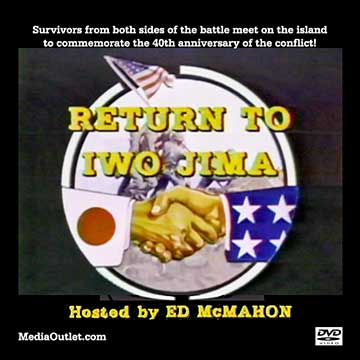
October 7: National Forgiveness &
Happiness Day: -- A day that celebrates forgiveness and the amount
of happiness it can bring to one's life. While many people hold on
to grudges and fantasize about revenge, studies have revealed that
the best way to heal is to actually forgive the person who hurt
you. And no, forgiving someone does not make you weak. Instead, it
contributes to the creation of a much more successful and happy
you. This National Forgiveness & Happiness Day, fill your
heart with the light of love and practice the art of forgiveness.
It will be the best decision you have made all year! The National
Forgiveness & Happiness Day is an occasion that celebrates
forgiveness and encourages people to let bygones be bygones. This
is because being unforgiving will only be harmful to you in the
long run and will have no impact on the one who hurt you. To
encourage the practice of 'letting go,' this religious-based
holiday was created and sponsored by Robert Moyers and the
Worldwide Forgiveness Alliance. The goal of the holiday was "to
do the will of God each day and to love one another as God loves
us." In fact, the organizers of the day also came up with a
"Prayer of Forgiveness," which asks God to forgive
others. It also pleads with God to provide us with the power to
forgive others and help one forgive oneself. Not the religious
kind? Well, this day is still important for you since the theory
of forgiveness and the impact it has on one's life has been
supported by numerous theorists and researchers. For instance, in
1998, two researchers revealed that forgiveness is different from
pardoning, excusing forgetting, and denial. Instead, it's an act
that allows you to reconcile with yourself and restore a fractured
relationship. This does not mean that you forget the wrong that
has been done to you, but instead, you focus on accepting that it
happened and then choose to move on. Another study revealed that
forgiveness increases positive emotions and reduces negative ones
such as blame and anger. Furthermore, in 2020, Shauna Shapiro
wrote in her book: "Forgiveness is perhaps the most
challenging of all the resources available to us - and the most
transformational." On Sale @ 15% Off Discount Till Midnight
PT!
https://store.earthstation1.com/return-to-iwo-jima-ed-mcmahon-dvd-survivors-of-both-sides-meet.html
Today's
EarthStation1.com 15% Off Commemorative Memorial Title: Sacrifice
At Pearl Harbor: Conspiracy Investigation MP4 Download DVD
Today,October 7, 2025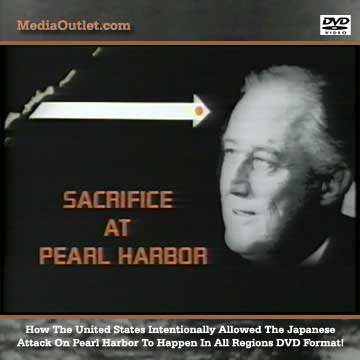
October 7, 1940: The European Civil War:
World War II: The Second European War (The European Theater Of
World War II): The Asia-Pacific War: Plots To Bring America Into
World War II: The McCollum Memo (The Eight Action Memo): --
Lieutenant Commander Arthur H. McCollum, who "provided the
president with intelligence reports on [Japan]... [and oversaw]
every intercepted and decoded Japanese military and diplomatic
report destined for the White House" in his capacity as
director of the Office of Naval Intelligence's Far East Asia
section, proposes bringing the United States into the war in
Europe by provoking the Japanese to attack the United States in a
document that became known as The McCollum memo, written fourteen
months before the Pearl Harbor attack. It was sent to Navy
Captains Dudley Knox, who agreed with the actions described within
the memo, and Walter Stratton Anderson. The memo outlined the
general situation of several nations in World War II and
recommended an eight-part course of action for the United States
to take in regard to the Japanese Empire in the South Pacific,
suggesting the United States provoke Japan into committing an
"overt act of war". The memo illustrates several people
in the Office of Naval Intelligence promoted the idea of goading
Japan into war: "It is not believed that in the present state
of political opinion the United States government is capable of
declaring war against Japan without more ado... If by [the
elucidated eight-point plan] Japan could be led to commit an overt
act of war, so much the better.". The McCollum memo contained
an eight-part plan to counter rising Japanese power over East
Asia: 1. Make an arrangement with Britain for the use of British
bases in the Pacific, particularly Singapore; 2. Make an
arrangement with the Netherlands for the use of base facilities
and acquisition of supplies in the Dutch East Indies; 3. Give all
possible aid to the Chinese government of Chiang-Kai-Shek; 4. Send
a division of long range heavy cruisers to the Orient,
Philippines, or Singapore; 5. Send two divisions of submarines to
the Orient; 6. Keep the main strength of the U.S. fleet now in the
Pacific[,] in the vicinity of the Hawaiian Islands; 7. Insist that
the Dutch refuse to grant Japanese demands for undue economic
concessions, particularly oil; 8. Completely embargo all U.S.
trade with Japan, in collaboration with a similar embargo imposed
by the British Empire. On Sale @ 15% Off Discount Till Midnight
PT!
https://store.earthstation1.com/sacrifice-at-pearl-harbor-dvd-us-let-attack-happen.html
Today's
EarthStation1.com 15% Off Commemorative Memorial Title: The
American Adventure: TV History Series 1607-1876 DVD MP4 USB Drive
Today,October 7, 2025
October 7, 1765: The Age Of Enlightenment
(The Enlightenment, The Age Of Reason): The Age Of Revolution: The
Atlantic Revolutions: The American Enlightenment: The American
Revolution: The Stamp Act 1765 (The Duties In American Colonies
Act 1765, The Stamp Act): The Stamp Act Congress (The First
Congress Of The American Colonies): -- Representatives from nine
of the colonies attend a meeting convened in New York City in
protest to the British Stamp Act which imposed the first direct
tax on Americans, the first gathering of elected representatives
from several of the American colonies to devise an unified protest
against British taxation. Parliament had passed the Stamp Act,
which required the use of specially stamped paper for legal
documents, playing cards, calendars, and newspapers for virtually
all business in the colonies, and went into effect March 22, 1765.
The Congress was organized in response to a circular letter
distributed by the colonial legislature of the Province of
Massachusetts Bay, and consisted of delegates from nine of the
eighteen British colonies in North America. All nine of the
attending delegations were from the Thirteen Colonies that
eventually formed the United States of America. Although sentiment
was strong in some of the other colonies to participate in the
Congress, a number of royal governors took steps to prevent the
colonial legislatures from meeting to select delegates. The
Congress met in the building now known as Federal Hall (the first
example of Federal Style architecture in the United States), and
was held at a time of widespread protests in the colonies, some of
which were violent, against the Stamp Act's implementation. The
delegates discussed and united against the act, issuing a
Declaration of Rights and Grievances in which they claimed that
Parliament did not have the right to impose the tax because it did
not include any representation from the colonies. Members of six
of the nine delegations signed petitions addressed to Parliament
and King George III objecting to the Act's provisions. The
extra-legal nature of the Congress caused alarm in Britain, but
any discussion of the congress's propriety were overtaken by
economic protests from British merchants whose business with the
colonies suffered as a consequence of the protests and their
associated non-importation of British products. These economic
issues prompted the British Parliament to repeal the Stamp Act,
but it passed the Declaratory Act the same day, to express its
opinion on the basic constitutional issues raised by the
colonists; it stated that Parliament could make laws binding the
American colonies "in all cases whatsoever." On Sale @
15% Off Discount Till Midnight PT!
https://store.earthstation1.com/the-american-adventure-series-us-1st-century-4-dv14.html
Today's
EarthStation1.com 15% Off Commemorative Memorial Title: Command
Performance WWII Old Time Radio Series MP3 DVD, Download, USB
Today,October 7, 2025
( #JCKaelin here: Phil Schaap (RIP) said
Jo Jones was the greatest drummer who ever lived during a
Thanksgiving Day weekend edition of his WKCR-FM Traditions In
Swing radio show (of as-yet-undetermined date), rebroadcast from
an archival copy on the afternoon of Saturday, August 22, 2020).
========= October 7, 1911: #BOTD: #HBD! Jo Jones, African American
jazz drummer, band leader and pioneer in jazz percussion, "the
greatest drummer who ever lived" according to WKCR jazz
historian Phil Schaap (d. September 3, 1985) is #born Jonathan
David Samuel Jones in Chicago, Illinois. He anchored the Count
Basie Orchestra rhythm section from 1934 to 1948. He was sometimes
known as Papa Jo Jones to distinguish him from younger drummer
Philly Joe Jones. Born in Chicago, Illinois, Jones moved to
Alabama, where he learned to play several instruments, including
saxophone, piano, and drums. He worked as a drummer and tap-dancer
at carnival shows until joining Walter Page's band, the Blue
Devils in Oklahoma City in the late 1920s. He recorded with
trumpeter Lloyd Hunter's Serenaders in 1931, and later joined
pianist Count Basie's band in 1934. Jones, Basie, guitarist
Freddie Green and bassist Walter Page were sometimes billed as an
"All-American Rhythm section," an ideal team. Jones was
with Basie in 1934 and then from 1936 to 1944, took a break to
serve in the U.S. Army from 1944 to 1946,and rejoined Basie in
1946, where he remained until 1948. He participated in the Jazz at
the Philharmonic concert series. He was one of the first drummers
to promote the use of brushes on drums and shifting the role of
timekeeping from the bass drum to the hi-hat cymbal. Jones had a
major influence on later drummers such as Buddy Rich, Kenny
Clarke, Roy Haynes, Max Roach, and Louie Bellson. He also starred
in several films, most notably the musical short Jammin' the Blues
(1944). Jones performed regularly in later years at the West End
jazz club at 116th and Broadway in New York City. These
performances were generally very well attended by other drummers
such as Max Roach and Roy Haynes. In addition to his artistry on
the drums, Jones was known for his irascible, combative
temperament. One famous instance of his irritable temper was in
the spring of 1936, when he threw a cymbal on the ground in front
of a very young Charlie Parker when he failed to improvise after
losing the chord changes. In contrast to the prevailing jazz drum
style exemplified by Gene Krupa's loud, which involved insistent
pounding of the bass drum on each beat, Jones often omitted bass
drum playing altogether. Jones also continued a ride rhythm on
hi-hat while it was continuously opening and closing instead of
the common practice of only striking it while it was closed.
Jones's style influenced the modern jazz drummer's tendency to
play timekeeping rhythms on a cymbal that is now known because of
him as the ride cymbal. In 1979, Jones was inducted into the
Alabama Jazz Hall of Fame for his contribution to the Birmingham,
Alabama musical heritage. Jones was the 1985 recipient of an
American Jazz Masters fellowship awarded by the National Endowment
for the Arts. His autobiography (as told to Albert Murray),
entitled Rifftide: The Life and Opinions of Papa Jo Jones and
based on conversations between Jones and novelist Murray from 1977
to before Jones' death in 1985, was posthumously published in 2011
by the University of Minnesota Press. On September 3, 1985, Jo
Jones died of pneumonia in New York City at the age of 73. Known
as Papa Jo Jones in his later years, he is sometimes confused with
another influential jazz drummer, Philly Joe Jones. The two died
only a few days apart; Papa Jo Jones died of pneumonia in New York
City at the age of 73, while Philly Joe Jones died on August 30.
Papa Jo is buried at Calverton National Cemetery in Calverton, New
York. He is buried at Calverton National Cemetery in Calverton,
New York. On Sale @ 15% Off Discount Till Midnight PT!
https://store.earthstation1.com/command-performance-in-world-war-ii-radio-broadcasts-mp3-c3.html
Today's
EarthStation1.com 15% Off Commemorative Memorial Title: Allen
Ginsberg: When The Muse Calls, Answer! DVD, Download, USB Drive
Today,October 7, 2025
October 7, 1955: Literature: The History
Of Literature: Censorship: Obscenity Controversies In Literature:
Freedom Of Speech (Freedom Of Expression): Howl (Howl For Carl
Solomon): -- American poet Allen Ginsberg gives the first public
performance of his poem "Howl", considered to be one of
the great works of American literature and came to be associated
with the group of writers known as the Beat Generation, at the Six
Gallery in San Francisco. It is a poem written by Allen Ginsberg
in 1955, published as part of his 1956 collection of poetry titled
Howl and Other Poems, and dedicated to Carl Solomon. Ginsberg
began work on "Howl" as early as 1954. In the Paul
Blackburn Tape Archive at the University of California, San Diego,
Ginsberg can be heard reading early drafts of his poem to his
fellow writing associates. "Howl" contains many
references to illicit drugs and sexual practices, both
heterosexual and homosexual. Customs officials seized 520 copies
of the poem on March 25, 1957, being imported from the printer in
London. On October 3, 1957, the California State Superior Court
ruled that it is not obscene. On Sale @ 15% Off Discount Till
Midnight PT!
https://store.earthstation1.com/allen-ginsberg-when-the-muse-calls-answer-in-my-kitchen-dvd.html
Today's
EarthStation1.com 15% Off Commemorative Memorial Title: The Race
For Space 1961 Historic Soviet Space Films DVD, Download, USB
Today,October 7, 2025
October 7, 1959: The History Of Rocketry:
The History Of Spaceflight: The Aftermath Of World War II: The
Cold War: The Space Age: The Space Race: The Discovery And
Exploration Of The Solar System: Missions To The Moon: Space
Probes: Lunar Space Probes: The Soviet Space Program: The Luna
Programme (Pejorative: The Lunik Program): Luna 3 (E-2A No.1,
Pejorative: Lunik 3, Lunik III): -- The U.S.S.R.'s lunar space
probe Luna 3 transmits the first ever photographs of the far side
of the Moon. Luna 3, pejoratively called Lunik 3 on occassion by
Western media, was launched on October 4, 1959 at 00:43:40 UTC
atop a Luna 8K72 launch vehicle from the Baikonur Cosmodrome's
Baikonur Site 1 (Site 1/5, Gagarin's Start) launch site in the
Kazakh Soviet Socialist Republic (modern Kazakhstan) on the second
anniversary of the launch of Sputnik I, the world's first
artificial satellite. It was the third Soviet space probe to be
sent to the neighborhood of the Moon, the first successful
three-axis stabilized spacecraft, and the first-ever mission to
photograph the far side of the Moon, the lunar hemisphere that
always faces away from Earth, opposite to the near side, because
of synchronous rotation in the Moon's orbit. Although Luna 3
returned rather poor pictures by later standards, the historic,
never-before-seen views of the far side of the Moon caused
excitement and interest when they were published around the world,
and a tentative Atlas of the Far Side of the Moon was created
after image processing improved the pictures. These views showed
mountainous terrain, very different from the near side, and only
two dark, low-lying regions which were named Mare Moscoviense (Sea
of Moscow) and Mare Desiderii (Sea of Desire). Mare Desiderii was
later found to be composed of a smaller mare, Mare Ingenii (Sea of
Ingenuity), and several other dark craters. The reason for this
difference between the two sides of the Moon is still not fully
understood, but it seems that most of the dark lavas that flowed
out to produce the maria formed under the Earth-facing half.
During most of the mission, the spacecraft was spin stabilized,
but for photography of the Moon, the spacecraft oriented one axis
toward the Sun and then a photocell was used to detect the Moon
and orient the cameras towards it. Detection of the Moon signaled
the camera cover to open and the photography sequence to start
automatically. The images alternated between both cameras during
the sequence. After photography was complete, the film was moved
to an on-board processor where it was developed, fixed, and dried.
Commands from the Earth were then given to move the film into a
flying spot scanner where a spot produced by a cathode ray tube
was projected through the film onto a photoelectric multiplier.
The spot was scanned across the film and the photomultiplier
converted the intensity of the light passing through the film into
an electric signal which was transmitted to the Earth (via
frequency-modulated analog video, similar to a facsimile). A frame
could be scanned with a resolution of 1000 (horizontal) lines. On
Sale @ 15% Off Discount Till Midnight PT!
https://store.earthstation1.com/the-race-for-space-dvd-1961-secret-soviet-f1961.html
Today's
EarthStation1.com 15% Off Commemorative Memorial Title: Terror:
The Israeli-Palestinian Conflict DVD MP4 Video Download
Today,October 7, 2025
October 7, 1985: The Arab-Israeli
Conflict: The Israeli-Palestinian Conflict: Terrorist Attacks
Attributed To Palestinian Militant Groups: The Palestinian
Liberation Front (PLF): The Achille Lauro Hijacking: The Sigonella
Crisis (The Crisis Of Sigonella): -- The Achille Lauro Hijacking
occurs when the Italian ocean liner MS Achille Lauro is hijacked
by four men representing the Palestine Liberation Front (PLF) off
the coast of Egypt, as she was sailing from Alexandria to Ashdod,
Israel. A 69-year-old Jewish American man in a wheelchair, Leon
Klinghoffer, was murdered by the hijackers and thrown overboard.
The exact circumstances of the hijacking remain disputed, with Abu
Abbas claiming one version of events and the Italian courts later
ruling it implausible. The Italian court later rejected Abbas's
explanation, citing inconsistencies. What is certain is that the
four terrorists stormed into the ship's dining room. They fired
their automatic weapons over the heads of the eating passengers.
Screams from the passengers meshed with the shouting of the gunmen
and with the sound of falling glass shards and splinters. Inside
the kitchen, one of the terrorists beat two of the kitchen staff
to the floor. The ship's executive officer notified Captain
Gerardo de Rosa that there were armed men on board, shooting at
passengers. Captain De Rosa descended quickly through several
decks, moving towards the ship's stern. An agitated voice came
over the ship's loudspeakers requesting that he come immediately
to the bridge. Arriving there, De Rosa was faced with machine
guns. The terrorists fired some shots into the deck and then
shouted in Arabic. They demanded he sail the ship 300 miles to the
northeast, to the Syrian port of Tartus. Due to most of the
passengers having disembarked at Alexandria to tour the pyramids,
only 97 remained on board and became hostages. The hijackers
rounded up the rest of the passengers aboard and herded them into
the dining room. The terrorists ordered Captain De Rosa to
instruct the 450 crew members to continue with their normal duties
but to stay clear of the hostages. They claimed to have a total of
20 hijackers on board. Only later would De Rosa and his officers
discover that there were only four hijackers. Within the dining
room, the terrorists put on displays of power to intimidate the
hostages, menacing them with their machine guns, and pulling the
pins from their grenades but keeping the safety levers depressed.
They had two of the women hostages hold the live grenades, causing
the worry that if they fell asleep, the safety levers would
detach, causing an explosion. The hijackers veered erratically
from politeness to barbarity - one moment one would wash a cup for
a hostage to use, the next a hijacker would ram a gun stock into
Mrs. Klinghoffer to force her from the floor, then a hijacker
would escort a captive to her cabin to change out of a wet
swimsuit. The hijackers also tried to engage in some political
persuasion, telling the hostages "Reagan no good, Arafat
good." Before the hijackers enforced radio silence, the crew
of the Achille Lauro managed to send out an S.O.S. that was picked
up by a monitoring facility in Sweden. This alerted the
international community that Palestinians had seized an Italian
ship. As night approached, the hijackers took all the hostages up
several decks to the Arazzi Lounge on the Promenade deck and gave
them blankets to spend the night. While they ordered the ship's
kitchen to send food up for the hostages, they placed containers
they claimed were filled with gasoline around the room (apparently
as a bluff to ward off the ship's crew). Despite fears of grenades
and gasoline, the passengers attempted to sleep on the floor while
the ship sailed for Syria. Upon learning of the hijacking and that
there were Americans on board, members of the Reagan
administration in Washington, D.C., in a time zone seven hours
behind Egypt's, moved to take decisive action. The Terrorist
Incident Working Group (which included National Security Council
staff member U.S. Marine Corps LtCol Oliver North) met in accord
with predetermined counter-terrorist procedures. They recommended
that a State Department Emergency Support Team be sent to Rome to
assist the embassy there as the vessel was Italian. The Group also
recommended that the Pentagon dispatch a team of special
operations forces to Europe in case the ship needed to be seized
to rescue the hostages. These recommendations were approved by the
Operational Sub-Group chaired by John Poindexter and orders were
sent to the State and Defense Departments. U.S. Army MG Carl
Stiner put two platoons, drawn from the Navy's counter-terrorism
unit SEAL Team Six, Army commandos from Delta Force, and Air Force
Combat Controllers from BRAND X, en route to Europe to be
operating with NATO ally permission from a British base at
Akrotiri, Cyprus. The U.S. State Department asked countries along
the Mediterranean to deny Achille Lauro access to their ports in
order to keep it in international waters. They also sought to keep
the press away from the ship to prevent giving the terrorists a
worldwide stage. The Italian Government took a mixed approach.
Defense Minister Giovanni Spadolini had the military send 60
paratroopers, four helicopters, and experts on the ship's layout
to the British base at Akrotiri. Prime Minister Bettino Craxi
looked for a diplomatic solution beginning a near-continuous
dialogue with every country involved, including the nations with
citizens aboard, and the Arab states of Egypt, Syria, Jordan, and
Tunisia. Italy had called on the PLO to publicly declare whether
they had any involvement. In response Yasser Arafat denounced the
hijacking and offered to assist in negotiating for a peaceful
conclusion to the incident. Arafat sent two men to Egypt to join a
joint negotiating team alongside Italians and Egyptians - one of
his advisors and PLO executive committee member Hani al-Hassan and
Abu Abbas. At Port Said, Egypt, these two joined the PLO
representative from Cairo - Zohdi al-Qoudra. (It is unknown if
Arafat was ignorant of Abbas's involvement or if he was sent to
ensure the incident would end quickly.) On the morning of Tuesday,
October 8, the hijackers began to separate the hostages. They were
looking for Jews and Americans, asking for the hostages to
identify themselves but meeting refusal. They collected the
passports of the passengers and pulled aside 12 Americans and six
female British dancers who had been hired as entertainers
(originally set to perform in the very lounge they were being held
hostage in). Looking at the passports of an elderly couple, the
hijackers asked if they were Jewish. Upon hearing that they were,
one of the terrorists knocked the man to the floor and repeatedly
hit him with the butt of his gun. The terrorists ordered the 20
separated passengers up the stairs but Leon Klinghoffer's
wheelchair could not make the climb and his wife Marilyn refused
to abandon him. She was ordered by the terrorists to leave him,
when she protested they put a machine gun to her head and ordered
her up the stairs. Fellow passenger Anna Scheider offered to take
Mr. Klinghoffer but was refused, with one of the hijackers saying
"You go! We will take care of him." On Lido Deck, below
the bridge and above the lounge the other hostages were being held
on, the separated hostages were forced to lie on the deck.
Containers said to contain fuel were placed around them with
threats from the terrorists that they would shoot the cans if
provoked. One of the terrorists told hostage Evelyn Weltman that
if commandos tried a rescue all the hostages would be executed. At
this point it became clear to the hostages and Captain De Rosa
that one of the four hijackers was their leader - twenty-three
year-old Youssef Majed Molqi (recruited by Abbas from a crowded
Palestinian refugee camp in Jordan). The Achille Lauro arrived off
Tartus at 11:00 a.m. and Molqi broke radio silence. He asked
Syrian authorities to allow him to dock the ship at Tartus and
demanded that they send someone from the International Red Cross
to the ship, along with British and American representatives. He
stated that he was with the PLF and demanded that the Israeli
Government be contacted and given the demand that 50 Palestinians
held in its jails be freed, including specifically Samir Kuntar.
If the prisoners were not released, Molqi said they would begin
killing hostages, "We will start executing at 3:00 p.m.
sharp." Syria, having consulted with the U.S. and Italian
governments, did not respond to any of the demands. As 3:00 p.m.
neared, the terrorists began to decide whom to kill by shuffling
the U.S., British, and Austrian hostages' passports. They selected
Leon Klinghoffer to be killed first, to be followed by Mildred
Hodes. Molqi shot Leon Klinghoffer once in the head and again in
the chest. He died instantly, toppling onto his face. Molqi then
went in and ordered De Souza to throw the body over the side of
the ship. When De Souza was unable to do the task alone, Molqi
found Italian hairdresser Ferruccio Alberti and forced the two of
them at gunpoint to throw the body and then the wheelchair into
the sea. Several of the hostages heard the shots and splashes,
including Marilyn Klinghoffer. She pleaded with the hijackers to
let her see her husband in the infirmary, but they refused. She
feared the worst but remained hopeful. Molqi, with blood
splattered clothing, returned to the other terrorists and told
them "I have killed the American." He and Bassam
al-Ashker then went to the bridge. Handing Klinghoffer's passport
to Captain De Rosa, he raised a finger and said "boom, boom."
He then handed Mrs. Hodes' passport to him and said "This
will be the second one." At that point, De Rosa told them
they could kill him instead of the passengers. Molqi ordered De
Rosa to tell the Syrians that a passenger had been killed and that
they were prepared to kill another. The Syrians responded by
telling Molqi to "go back where you came from." Finding
no help in Syria, Molqi ordered De Rosa to sail for Libya. The
Israelis were able to provide information about Abbas' radio
discussions with the ship to the Reagan administration and
notified them that it was Abbas' faction behind the hijacking.
Fearing that the terrorists' threat to kill passengers had been
followed through, and not wanting a repeat of the TWA Flight 847
terrorist incident where the administration looked impotent to
act, the American special forces staged in Cyprus were ordered to
make preparations to storm the vessel. That afternoon, Maxwell M.
Rabb, U.S. ambassador to Italy, advised Prime Minister Craxi of
the U.S. intention to mount a military assault on the vessel,
after Italy had already weighed taking the same action. Craxi
protested, saying the ship was Italian, and therefore only Italy
should act and that there was no confirmation of any killings. He
maintained that negotiations for the release of the ship seemed
possible. He relayed that in response to his inquires the
Egyptians had told him that no one had been killed. The Egyptian
Government began to conduct negotiations through the medium of PLO
representative Muhammad "Abu" Abbas. At 7:30 a.m.
Wednesday, October 9, the Achille Lauro anchored off Port Said.
While the hostages remained in the lounge, a small boat approached
the ship. Molqi descended to speak with the new arrivals which
included Abu Abbas and Hani al-Hassan. Speaking with the support
of both the Egyptian and Italian officials, Abbas and Hassan began
talking to the hijackers - giving the appearance of real
negotiations. By Wednesday morning, the Reagan administration had
implemented a plan for the Achille Lauro to be liberated by the
U.S. military that evening. SEAL Team Six embarked on board the
USS Iwo Jima (LPH-2) an amphibious assault ship which then steamed
for Port Said. It was decided that the raid would go ahead as long
as the ship was in international waters, but would be put on hold
if it was found in Egyptian waters. At mid-afternoon Wednesday, a
ship-to-shore radio broadcast was made by Captain De Rosa, "I
am the captain. I am speaking from my office, and my officers and
everybody is in good health". It was later discovered that De
Rosa had made this false claim because Molqi was holding a gun to
his head. At 5:00 p.m., the four Palestinian hijackers left the
ship being taken ashore by the Egyptians in a tugboat. The
terrorists waved goodbye to the former hostages, who applauded in
relief at finding themselves freed. A crowd of Egyptian civilians
ashore burst into cheers for the hijackers as they came into view
of land, "Fedayeen, fedayeen, Allah akbar!" ("The
guerrillas, the guerrillas, God is great!"). British
journalist Robert Fisk reported from the shore that one could see
a streak down the side of the vessel, which turned out to be
Klinghoffer's blood. As soon as the hijackers left the ship
Marilyn Klinghoffer rushed to the infirmary looking for Leon. Not
finding him the staff informed her to ask the captain who was
still on the bridge. Klinghoffer climbed the steps on the
infirmary's level - near the bottom of the ship, all the way to
the bridge - near the top of the vessel. Captain De Rosa informed
her of her husband's murder. Klinghoffer collapsed, sobbing
uncontrollably, and friends helped her to her cabin. De Rosa
received a call from Italian Foreign Minister Giulio Andreotti in
Rome. He confirmed that he had regained control of the ship but
inexplicably relayed that all of the passengers were well.
Andreotti informed Craxi, who was about to hold a press
conference, on the successful conclusion of the situation. Craxi
decided that it was best to double check the condition of the
passengers and called De Rosa who finally admitted the murder of
Leon Klinghoffer. Craxi altered his prepared remarks and at the
news conference the world learned from him of the murder for the
first time. The Klinghoffers' daughters and friends in New York
had been celebrating the previous news which claimed all the
hostages were safe, but were contacted by the New York Times which
had a reporter at the Craxi press conference. Informed of the
death of their father and friend, their joy turned into despair.
American ambassador Nicholas Vliotes boarded the Achille Lauro to
confirm Craxi's information about Klinghoffer's death. He found De
Rosa distraught, learned that Molqi had held the gun to his head
during the ship-to-shore communication that claimed all the
hostages were healthy. De Rosa in tears handed the ambassador
Klinghoffer's passport. Veliotes called the American embassy with
the ship-to-shore radio to give orders "Leon Klinghoffer was
murdered by the terrorists off of Tartus when they were trying to
get the attention of the Syrians. In my name, I want you to call
the [Egyptian] foreign minister, tell him what we learned, tell
him the circumstances, tell him in view of this and the fact that
we - and presumably them - didn't have those facts, we insist that
they prosecute those sons of bitches." The American
passengers of the Achille Lauro, having been held hostage for 51
hours, were taken by a U.S. military aircraft back to the United
States on October 12, 1985. The aircraft had flown out of
Rhein-Main Air Base, West Germany, and stopped there for refueling
during the flight to the United States from Egypt. With the
hijackers on Egyptian soil and the knowledge of Klinghoffer's
murder revealed, different state actors put forward their position
on what should be done. Italy's position was that the ship being
Italian, it was legally Italian territory and therefore the
hijackers should be extradited to Italy. Israel demanded that the
hijackers be prosecuted, Benjamin Netanyahu (its representative to
the United Nations) declared "Klinghoffer and his wife were
singled out for one thing - because they were Jewish." When
Abbas had ordered the hijackers to return the ship to Port Said,
and the ship's captain had radioed Egyptian port officials - the
problem fell onto Egypt's President Hosni Mubarak. The Egyptian
government had competing interests he was attempting to balance.
Mubarak wanted to maintain Egypt's peace treaty with Israel, the
1978 Camp David Accords, but also keep good relations with its
fellow Arab states in the Middle East. The Israeli bombing of the
PLO's Tunis headquarters the previous week had left many innocent
Tunisians killed or wounded, adding to the pressures on Mubarak.
He also wanted to maintain good relations with the US to not
jeopardize billions of dollars in foreign aid. Mubarak decided to
try to get the hijackers out of Egypt quickly. He thought this
would work because of the recent previous precedent where the U.S.
had "made no claims on the hijackers" of the TWA
airliner earlier that summer. Additionally President Reagan had
told the media that it would be "all right" if the PLO
put the hijackers on trial. Mubarak's main impetus for his
decision was Captain De Rosa's false report of no casualties. The
Egyptian government had intervened solely for humanitarian reasons
to secure the release of the hostages and the vessel. Egypt had no
normal basis for jurisdiction as the ship was of Italian registry,
carried no Egyptian passengers, none of the hijackers were
Egyptian, and their actions were outside Egyptian territorial
limits. The Egyptian government decided to honor its agreement to
allow the Palestinians access to a plane to travel to a place of
safety. The Egyptian government had given PLO officials in Tunisia
48 hours to take control of the four hijackers in Egypt. Arafat
had told the Egyptians that he needed time to find a nation that
they could take the four for trial. If the PLO could not find a
cooperative nation, Egypt would release the men or turn them over
to Italy. The PLO did not feel anxious about the agreement, one of
its officials saying "Italy is a friend of ours, so it's no
problem." The PLO also asserted that the four were not PLO
members but only a part of the PLF. Some in the international
community, such as the US, held that this was a common tactic by
Arafat. Holding that when one of the PLO's constituent groups
committed an act of violence, he would claim that the group was
rebelling from PLO control and beyond his control or influence.
PLO official Farouk Kaddoumi also said that the claim that
Klinghoffer had been murdered was "a big lie fabricated by
the intelligence service of the United States." At a United
Nations meeting in New York, he suggested to the UN Security
Council that Klinghoffer might have died naturally, "Is there
any evidence that those hijackers had killed the civilian? Where
is the evidence?" The Reagan administration sent a series of
urgent messages to Cairo, urging the Egyptians to swiftly turn
over the hijackers for prosecution either to Italy or the US.
Reagan approved of a draft message to be sent on his personal
behalf to Mubarak stating the same was to be delivered by
Ambassador Veliotes. Apparently seeking to avoid having to lie
directly to the Americans, Mubarak refused to see Veliotes and
also refused to take calls from George Shultz. On the morning of
Thursday, October 10, 1985, Oliver North contacted Israeli Major
General Uri Simhoni, the military attache at the Israeli embassy
in Washington. (Simhoni had been helpful in giving information
that helped locate the Achille Lauro during the hijacking.) He
relayed to North that the four hijackers were at the Almaza Air
Base near Cairo. Later that morning American sources confirmed the
information and added that the Egyptians were planning to
transport the men out of the country at night, presumably to
Tunis, aboard a commercial EgyptAir jet. After listening to the
idea of intercepting the EgyptAir jet, Reagan approved the
operation in principle in what was called the "Sara Lee
decision". Reagan's decision style was to reflect the
broad-brush issues and leave details to his staff, and John
Poindexter, chair of the Operational Sub-Group tasked with
fulfilling the president's decision. North was to remain in
contact with Simhoni for any situational changes regarding the
hijackers. Poindexter called Vice Admiral Art Moreau (then serving
as assistant to Admiral William J. Crowe - the chairman of the
Joint Chiefs of Staff). Poindexter, on behalf of the president,
told Moreau that Crowe was to start planning an intercept mission.
The final go-ahead was given by Reagan late that afternoon while
returning to Washington on Air Force One. McFarlane contacted
Poindexter who alerted the Pentagon. Orders were sent across the
Atlantic to the aircraft carrier USS Saratoga and her aircraft
made ready for the intercept. On October 10, 1985, the four
hijackers boarded an EgyptAir Boeing 737 accompanied by Abu Abbas,
Ozzuddin Badrakkan (also called Mohammed Oza - he served as chief
of PLF military operations and was a PLO official), and several
members of Egypt's counterterrorism unit Force 777. The flight was
set to fly to Tunisia, which was where the PLF headquarters were
located. The airliner took off from Cairo at 4:15 p.m. EST. During
the flight, United States Navy F-14 fighter jets intercepted the
plane carrying the terrorist hijackers, and forced it to land at a
NATO base in Sigonella, Sicily where they were arrested, sparking
The Sigonella Crisis, a diplomatic incident between Italy and the
United States that risked escalating into an armed confrontation
between Italy's VAM (Vigilanza Aeronautica Militare) and
Carabinieri rural police (gendarmerie) on the one hand, and
soldiers of America's Delta Force special forces unit on the
other, as a political rupture occurred between Italian Prime
Minister Bettino Craxi and U.S. President Ronald Reagan about the
fate of the terrorists who had hijacked the Achille Lauro and
killed a US passenger. Sigonella was an Italian Air Force base in
Sicily, which housed a U.S. Navy installation (N.A.S.). The
American special forces had surrounded the airplane, but soon
found themselves surrounded by Italian Air Force soldiers and
Carabinieri military police. The Italian organizations insisted
that Italy had territorial rights over the base and jurisdiction
over the hijackers. A standoff between the SEAL team and the
Italian military began. The choice of the Sigonella base to divert
the EgyptAir 737 that had the hijackers of the Achille Lauro
aboard caused a dispute between the governments of the US and
Italy and included elements of their militaries. On the orders of
U.S. president Ronald Reagan and Secretary Of Defense Caspar
Weinberger, the Egyptian airliner carrying the hijackers was
intercepted by F-14 Tomcats from the VF-74 "BeDevilers"
and the VF-103 "Sluggers" of Carrier Air Wing 17, based
on the aircraft carrier USS Saratoga, and directed to land at
Naval Air Station Sigonella (an Italian NATO air base in Sicily
under joint Italian-American military utilization). The choice of
Sigonella became problematic for the Americans as they had no
jurisdiction, and the Italians were not consulted regarding its
use for this operation. The Egyptian flight, having been
authorized by its government, was lawful under international law.
The Egyptian government protested the American interception of its
plane, which was not legal under international law. Egypt's
arguments were somewhat diminished by its own previous
justification for its 1978 raid at Locna airport in Cyprus. Not
only had the Americans not received consent from the Italians to
forcibly land a non-hostile plane flying in compliance with
international law at Sigonella, but the American military action
was taken solely for American purposes (not those of the NATO
alliance) and was taken in order to secure criminals - this was in
violation of the purely joint military purposes that the Italians
had agreed to when deciding to share the utilization of the base.
A standoff occurred when 20 Carabinieri and 30 VAM (Vigilanza
Aeronautica Militare) of the Italian Air Force contested for
control of the plane with the 80 armed operatives of the U.S.
Delta Force and SEAL Team Six. These contesting groups were soon
surrounded by 300 additional armed Carabinieri (the Italian
military police) who had also blocked off the runway with their
trucks. The Italian Air Force (VAM) personnel and Carabinieri had
already been lining up facing the US special forces soon after the
American's main contingent had arrived by C-141s. Other
Carabinieri had been sent from Catania and Syracuse as
reinforcement. These events became known as the Sigonella Crisis.
Stiner and Gormly contacted the Pentagon to inform them of the
situation, and this information was passed onto the Reagan
Administration. Members of the president's staff told the Italian
government that the US special-operations team intended to arrest
the hijackers. The Italians dismissed the Americans' claim of the
right to do so, maintaining that the matter fell within their own
jurisdiction due to the ship sailing under an Italian flag. A
phone call took place between President Reagan and the Prime
Minister Craxi. Craxi claimed Italian territorial rights over the
NATO base. Reagan informed Craxi that the US would seek
extradition of the terrorists to face charges in US courts. Stiner
and his men, standing eyeball-to-eyeball with the 360 armed
Italians, relayed to the Pentagon "I am not worried about our
situation. We have the firepower to prevail. But I am concerned
about the immaturity of the Italian troops... A backfire from a
motorbike or a construction cart could precipitate a shooting
incident that could lead to a lot of Italian casualties. And I
don't believe that our beef is with our ally, the Italians, but
rather with the terrorists." The American leadership in
Washington concluded that while Stiner and his men could take the
terrorists it was unlikely they would be able to get them out of
Italy. By 4:00 a.m. CET the next day, orders arrived for Stiner
and his men to stand down. After five hours of negotiations, and
with the knowledge that the Italian troops had orders (confirmed
by President Francesco Cossiga) to use lethal force if necessary
to block the Americans from leaving with prisoners, the U.S.
conceded the Italian claim of jurisdiction over the terrorists.
The Americans received assurances that the hijackers would be
tried for murder and Stiner and three US officials were to remain
at the airport to witness the arrest of the terrorists by Italian
authorities. After the U.S. turned over control of the 737 to
Italy, Egyptian diplomat Hamed returned to the plane with Italian
base commander Colonel Annicchiarico. Hamed told the men of Unit
777 that the Egyptian government had agreed to turn over the
hijackers to the Italians. Both Abbas and Badrakkan refused to
leave the plane claiming diplomatic rights - maintaining that they
had diplomatic immunity as representatives of the PLO and Arafat.
Learning of this the Egyptian government changed its position,
declaring that the two were on board an Egyptian aircraft on a
government mission - thus accruing extraterritorial rights. Egypt
requested Italy let the plane leave with the two men on board as
they had been brought to Italy against their will. When the
Italians refused this demand the Egyptians denied Achille Lauro
permission to leave Port Said. Prime Minister Craxi sent his
personal foreign affairs advisor Antonio Badini to interview Abbas
after boarding the airliner. Abbas' account held he had been sent
by Arafat due to his persuasive argumentation style, that the four
Palestinians had been triggered by panic to stage the hijacking,
and that the decisive role in releasing the passengers was his
alone. Craxi appeared at a press conference late on Friday,
October 11, acknowledging the role the two played in ending the
hijacking, but inviting them to provide "useful testimony"
and turning the matter over to the Italian court system. After
continued talks between Italy and Egypt, the four hijackers were
eventually removed from the 737, arrested by the Italian
Carabinieri at Sigonella, and taken to the air base jail, then
transferred to a local prison. The public magistrate in Syracuse
announced late on the 11th that his inquires were complete and
EgyptAir 2843 could depart for Rome with Badrakkan and Abbas
aboard. Craxi saw this as a stalling tactic that was a courtesy to
the U.S. The Italian foreign ministry contacted the U.S. embassy
and informed them of the flight, saying that the two wanted to
consult with the PLO office in Rome. The Americans viewed this as
a prelude to Abbas being released. The 737 was then cleared by the
Italians to fly to Rome's Ciampino airport with Abbas and
Badrakkan still aboard. U.S. Major General Stiner, in command of
the American Special Operations Forces at Sigonella, upon learning
that the 737 had been cleared by the Italians to proceed to Rome
with members of the PLF still onboard, became concerned that there
was no guarantee that once airborne it would travel to Rome rather
than back to Cairo. He boarded a T-39 Navy executive jet (the
North American Sabreliner) with other American Special Operations
personnel and planned to shadow the 737. When the Egyptian
airliner took off from Sigonella at 10:00 p.m. the T-39 was not
granted clearance from that runway. In response the Americans used
a parallel runway without Italian permission. In response to the
unauthorized act by Stiner and the Americans, the Italian Air
Force sent in two Aeritalia F-104S Starfighter warplanes of the
36_ Stormo (Wing) from Gioia del Colle. These were soon joined by
two more F-104s from Grazzanise airbase. In response to the
Italian action, other warplanes (that have never been publicly
identified but are assumed to have been American F-14 Tomcats)
came up behind the Italian jets. The Italian jets also found their
radar jammed above the Tyrrhenian Sea, assumingely by a U.S.
Northrop Grumman EA-6B Prowler. National Security Council staffer
Michael K. Bohn in the White House Situation Room at the time,
later recalled "Pilots on board the U.S. and Italian jets
exchanged colorful epithets over the radio about their respective
intentions, family heritage, and sexual preferences." Once
the 737 approached Rome, the formation of U.S. Naval fighters,
turned back - only the T-39 with U.S. special operations forces
continued to Ciampino airport. The Italian air-traffic controllers
at Ciampino denied the T-39 permission to land, but the US pilot
claimed there was an "inflight emergency" which gave him
an automatic right to land the jet. This American violation of
operating in Italian airspace and landing in a Roman airport
without overflight or landing permissions was seen by the Italians
as an affront to their laws and safety regulations and negatively
influenced diplomatic relations between the countries for some
time. Diplomatic relations with Egypt also were negatively
impacted as they continued to demand an apology from the U.S. for
forcing the airplane off course. On Sale @ 15% Off Discount Till
Midnight PT!
https://store.earthstation1.com/terror-the-israelipalestinian-conflict-dvd-mp4-video-downloa4.html
Today's
EarthStation1.com #OnThisDay Commemorative Memorial Title: Making
Sense Of The Sixties TV Series DVD, Video Download, USB Drive
Today,October 7, 2025 October 7: You Matter To Me Day: -- It
may not seem like a big deal to many, but do you realize how many
individuals have lost their loved ones without being given a
chance to tell them how important they are? Yes, expressing your
feelings regularly is one of the most critical and essential
aspects of any relationship. If you haven't been open to your
loved ones in recent times, use this day as an opportunity to tell
them how much they matter to you. In fact, you can even tell those
who aren't close to you how much their existence matters. Go all
out and spread the love! Relationships are essential for everyone.
Unfortunately, while relationships with friends, family, and
lovers fuel our lives, we often tend to ignore the people we love
the most. We don't show the people we love enough affection, nor
do we truly express how much they mean to us. The result? We don't
realize our mistakes till it's too late. To avoid this very
feeling of hopelessness and guilt, You Matter To Me Day was
created. The day was formed in 2010 by Linda Jew, who experienced
an incident that shook her to the core. Linda had a friend who was
important to her. But like all of us, she never expressed her
feelings towards her friend and his son. One day, both of them
passed away in an accident, and Linda was left with the desire to
show them how much they meant to her one last time. Unfortunately,
you can't turn back time and people don't return from the dead. To
make sure no one would ever feel the regret that she felt, Linda
began telling people around her that they mattered. She had
acknowledged the fact that life is short and we must utilize each
day to express what we feel so we wake up without any regrets.
Linda said to everyone: "You matter to me." And this is
how the day was created. The date of the day was also chosen
keeping in mind the astrological charts that showed a New Moon in
Libra, i.e. a time that represents new beginnings. The motto of
You Matter to Me Day is "Because everyone matters to someone,
and someone matters to you."
https://store.earthstation1.com/making-sense-of-the-sixties-tv-documentary-series-6-hour-episode6.html
October 7: You Matter To Me Day: -- It
may not seem like a big deal to many, but do you realize how many
individuals have lost their loved ones without being given a
chance to tell them how important they are? Yes, expressing your
feelings regularly is one of the most critical and essential
aspects of any relationship. If you haven't been open to your
loved ones in recent times, use this day as an opportunity to tell
them how much they matter to you. In fact, you can even tell those
who aren't close to you how much their existence matters. Go all
out and spread the love! Relationships are essential for everyone.
Unfortunately, while relationships with friends, family, and
lovers fuel our lives, we often tend to ignore the people we love
the most. We don't show the people we love enough affection, nor
do we truly express how much they mean to us. The result? We don't
realize our mistakes till it's too late. To avoid this very
feeling of hopelessness and guilt, You Matter To Me Day was
created. The day was formed in 2010 by Linda Jew, who experienced
an incident that shook her to the core. Linda had a friend who was
important to her. But like all of us, she never expressed her
feelings towards her friend and his son. One day, both of them
passed away in an accident, and Linda was left with the desire to
show them how much they meant to her one last time. Unfortunately,
you can't turn back time and people don't return from the dead. To
make sure no one would ever feel the regret that she felt, Linda
began telling people around her that they mattered. She had
acknowledged the fact that life is short and we must utilize each
day to express what we feel so we wake up without any regrets.
Linda said to everyone: "You matter to me." And this is
how the day was created. The date of the day was also chosen
keeping in mind the astrological charts that showed a New Moon in
Libra, i.e. a time that represents new beginnings. The motto of
You Matter to Me Day is "Because everyone matters to someone,
and someone matters to you."
https://store.earthstation1.com/making-sense-of-the-sixties-tv-documentary-series-6-hour-episode6.html
Today's
EarthStation1.com #OnThisDay Commemorative Memorial Title: 27 Wagons
Full Of Cotton Lesley Ann Warren Ray Sharkey DVD, MP4, USB
Today,October 7, 2025October 7: World Cotton Day: -- Cotton is
breathable, comfortable, durable, and hypoallergenic, which is why
it's one of the most featured fabrics in our wardrobes. Cotton
isn't just a commodity but an impactful product, affecting 28.67
million growers and millions of families worldwide. World Cotton
Day highlights cotton's role in providing jobs and maintaining
economic stability in the least developed countries (L.D.C.s). On
this day, the global community is invited to celebrate the world's
most important natural fiber. World Cotton Day was first launched
on October 7, 2019, following an initiative by the Cotton Four
countries: Benin, Burkina Faso, Chad, and Mali. The event was
organized by the World Trade Organization (W.T.O.) Secretariat
with the assistance of the secretariats of the United Nations Food
and Agriculture Organization (F.A.O.), the United Nations
Conference on Trade and Development (U.N.C.T.A.D.), the
International Cotton Advisory Committee (I.C.A.C.), and the
International Trade Centre (I.T.C.). It's an opportunity to share
knowledge about and showcase cotton-related activities and
products. Cotton is a safety net for the least-developed and
developing countries. It's a major source of income and livelihood
for many rural laborers and smallholders. While occupying 2.1% of
the world's arable land, cotton meets 27% of the world's textile
needs, and almost nothing from the product is wasted. It's used in
animal feed, cosmetics, edible oils, fuel, textiles, and more and
benefits more than 100 million families across 75 countries on
five continents. Cotton is a natural fiber - breathable,
comfortable, durable, versatile, and hypoallergenic. World Cotton
Day is observed to reflect the importance of cotton as a global
commodity. It's meant to attract donors and beneficiaries and
enhance cotton development assistance, recognize cotton and those
involved in producing and trading it, advance related technology
and research and development, and find new investors and partners
within the private sector.
https://store.earthstation1.com/27-wagons-full-of-cotton-dvd-tennesee-willia27.html
Today's
EarthStation1.com #OnThisDay Commemorative Memorial Title: Outer
Space Films 1 Project Mercury Start To Finish DVD, Download, USB
Today,October 7, 2025October 7, 1958: The Space Age: The
History Of Rocketry: The History Of Spaceflight: The Aftermath Of
World War II: The Cold War: The Space Age: The Space Race: Space
Programs Of The United States: Human Spaceflight Programs: Project
Mercury: -- American President Dwight Eisenhower secretly and
officially approves the first human spaceflight program of the
United States as Project Mercury, after he changed the name of the
program from Project Astronaut; Eisenhower felt that name gave too
much attention to the pilot, and he decided that the name Mercury,
chosen from classical Greco-Roman mythology, which had already
lent names to rockets like the Greek Atlas and Roman Jupiter for
the SM-65 and PGM-19 missiles, was a better name, as the name of
the god of speed Mercury better reflected the urgency of the space
race between the US and USSR to put a man into space first.
Accordingly, Project Mercury absorbed military projects with the
same aim, such as the Air Force Man In Space Soonest (MISS). The
project was publicly announced two months later, on December 17,
1958.
https://store.earthstation1.com/outer-space-films-1-project-mercury-start-to-finish-dv1.html
Today's
EarthStation1.com #OnThisDay Commemorative Memorial Title: The 1965
Edwards Air Force Base UFO Incident Audio CD
Today,October 7, 2025October 7, 1965: Unidentified Flying
Objects (UFOs, Unidentified Anomalous Phenomenon, UAPs): UFO
Incidents (Unidentified Flying Object Incidents): The Edwards Air
Force Base UFO Incident (The Edwards Air Force Base Unidentified
Flying Object Incident: -- Twelve Unidentified Flying Objects
appear over Edwards Air Force Base during an international
convention of rocket scientists concerned with the X-15 hypersonic
rocket-powered space plane project. A full forty minutes of live
audio recordings were declassifed, and are available in their
entirety from EarthStation1 MediaOutlet, including communications
with base radar operators, the control tower, the F-106 Delta Dart
scrambled to pursue them, telephone calls between members of the
chain of command at Edwards, and even a phone call with the base's
UFO office commander, a position not publicly admitted to at the
time.
https://store.earthstation1.com/the-1965-edwards-air-force-base-ufo-incident-audio-cd.html
Today's
EarthStation1.com #OnThisDay Commemorative Memorial Title: The Uncle
Dave Macon Program DVD, MP4 Video Download, USB Flash Drive
Today,October 7, 2025October 7, 1870: #BOTD: #HBD! Uncle Dave
Macon, American old-time country banjo player, singer-songwriter,
and comedian (d. March 22, 1952) is #born David Harrison Macon in
Smartt Station (about five miles south of McMinnville). Also known
as "The Dixie Dewdrop", Macon was known for his chin
whiskers, plug hat, gold teeth, and gates-ajar collar, he gained
regional fame as a vaudeville performer in the early 1920s before
becoming the first star of the Grand Ole Opry in the latter half
of the decade. Macon's music is considered the ultimate bridge
between 19th-century American folk and vaudeville music and the
phonograph and radio-based music of the early 20th-century. Music
historian Charles Wolfe wrote, "If people call yodelling
Jimmie Rodgers 'the father of country music,' then Uncle Dave must
certainly be 'the grandfather of country music'." Macon's
polished stage presence and lively personality have made him one
of the most enduring figures of early country music. Uncle Dave
Macon died at Rutherford County Hospital in Murfreesboro at the
age of 81. He is buried at Coleman Cemetery near Murfreesboro. On
Sale @ 15% Off Discount Till Midnight PT!
https://store.earthstation1.com/the-uncle-dave-macon-program-dvd.html
Today's
EarthStation1.com #OnThisDay Commemorative Memorial Title: Swing: The
Best Of The Big Bands DVD, MP4 Video Download, Flash Drive
Today,October 7, 2025October 7, 1988: #DOTD: #RIP: Billy
Daniels, African American singer active in the United States and
Europe from the mid-1930s to 1988, notable for his hit recording
of "That Old Black Magic" and his pioneering
performances on early 1950s television (b. September 12, 1915)
#dies of stomach cancer at the age of 73 in Los Angeles,
California. He is buried at the El Camino Memorial Park in
Sorrento Valley, San Diego, California. William Boone Daniels was
born in Jacksonville, Florida, to a father who was a postmaster
and notary, and a mother was a schoolteacher and organist. Daniels
had the distinguished heritage of Portuguese sailor, Native
American (Choctaw), African American, and frontiersman Daniel
Boone. He was one of the first African American entertainers to
cross over into the mainstream. Daniels was honored with a star on
the Hollywood Walk of Fame in 1977. On Sale @ 15% Off Discount
Till Midnight PT!
https://store.earthstation1.com/swing-the-best-of-the-big-bands-dvd-complete-tv-series-2-disc2.html
Today's
EarthStation1.com #OnThisDay Commemorative Memorial Title: A Night At
The Nuyorican Poet's Cafe 102690 DVD, Download, USB Drive
Today,October 7, 2025October 7, 1934: #BOTD: #HBD! Amiri
Baraka, American poet, playwright, author, essayist, music critic,
academic and beat (d. January 9, 2014) is #born Everett LeRoi
Jones in Newark, New Jersey. Previously known as LeRoi Jones and
Imamu Amear Baraka, he was the author of numerous books of poetry
and taught at several universities, including the State University
of New York at Buffalo and the State University of New York at
Stony Brook. He received the PEN/Beyond Margins Award in 2008 for
Tales of the Out and the Gone. Baraka's career spanned nearly 52
years, and his themes range from black liberation to white racism.
Some poems that are always associated with him are "The
Aesthetics: The Performing Arts: Music: Reflection on Jazz and
Blues", "The Book of Monk", and "New Music,
New Poetry", works that draw on topics from the worlds of
society, music, and literature. Baraka's poetry and writing have
attracted both high praise and condemnation. In the African
American community, some compare Baraka to James Baldwin and
recognize him as one of the most respected and most widely
published black writers of his generation. Others have said his
work is an expression of violence, misogyny, and
homophobia.Regardless of one's viewpoint, Baraka's plays, poetry,
and essays have been described by scholars as constituting
defining texts for African American culture. Baraka's brief tenure
as Poet Laureate of New Jersey (in 2002 and 2003) involved
controversy over a public reading of his poem "Somebody Blew
Up America?", which resulted in accusations of anti-Semitism
and negative attention from critics and politicians. Amiri Baraka
died at the age of 79 at Beth Israel Medical Center in Newark, New
Jersey, after being hospitalized in the facility's intensive care
unit for one month before his death. The cause of death was not
reported initially, but it is mentioned that Baraka had a long
struggle with diabetes. Later reports indicated that he died from
complications after a recent surgery. Baraka's funeral was held at
Newark Symphony Hall on January 18, 2014. His burial details are
not publicly disclosed.
PT!
https://store.earthstation1.com/a-night-at-the-nuyorican-poet39s-cafe-102690-dvd-download-u39102690.html
Today's
EarthStation1.com #OnThisDay Commemorative Memorial Title: New York
City History Documentary Collection MP4 Video Download DVD
Today,October 7, 2025October 7, 1955: #BOTD: #HBD! Yo-Yo Ma,
French-American cellist, teacher and humanitarian, is #born in
Paris, France to Chinese parents. Educated in New York City, Ma
was a child prodigy, performing from the age of four and a half.
He graduated from The Juilliard School and Harvard University, and
has performed as a soloist with orchestras around the world. He
has recorded more than 90 albums and received 18 Grammy Awards. In
addition to recordings of the standard classical repertoire, he
has recorded a wide variety of folk music such as American
bluegrass music, traditional Chinese melodies, the tangos of
Argentinian composer Astor Piazzolla, and Brazilian music. He has
collaborated with artists including jazz singer Bobby McFerrin,
guitarist Carlos Santana, Sergio Assad and his brother, Odair, and
singer-songwriter and guitarist James Taylor. Ma's primary
performance instrument is a Montagnana cello crafted in 1733 and
valued at 2.5M USD. He has been a United Nations Messenger of
Peace since 2006. He was awarded The Glenn Gould Prize in 1999,
the National Medal of Arts in 2001, Presidential Medal Of Freedom
in 2011, and Polar Music Prize in 2012. Ma is included in Time
magazine 's 100 Most Influential People of 2020. On Sale @ 15% Off
Discount Till Midnight PT!
https://store.earthstation1.com/new-york-city-history-videos-3-dvd-se3.html
Today's
EarthStation1.com #OnThisDay Commemorative Memorial Title: American
Revolutionary War Documentaries DVD, Download, USB Drive
Today,October 7, 2025October 7, 1777: The Age Of Enlightenment
(The Enlightenment, The Age Of Reason): The Age Of Revolution: The
Atlantic Revolutions: The American Enlightenment: The American
Revolution: The American Revolutionary War: Battles Of The
American Revolutionary War In New York State: The Saratoga
Campaign: The Battles Of Saratoga: The Second Battle Of Saratoga
(The Battle Of Bemis Heights): -- The Americans defeat the British
in the Second Battle Of Saratoga, also known as the Battle of
Bemis Heights. The Battles of Saratoga (September 19 and October
7, 1777) marked the climax of the Saratoga campaign, giving a
decisive victory to the Americans over the British in the American
Revolutionary War. British General John Burgoyne led a large
invasion army southward from Canada in the Champlain Valley,
hoping to meet a similar British force marching northward from New
York City and another British force marching eastward from Lake
Ontario; the southern and western forces never arrived, and
Burgoyne was surrounded by American forces in upstate New York. He
fought two small battles to break out which took place 18 days
apart on the same ground, 9 miles (14 km) south of Saratoga, New
York. They both failed. Burgoyne found himself trapped by superior
American forces with no relief, so he retreated to Saratoga (now
Schuylerville) and surrendered his entire army there on October
17. His surrender, says historian Edmund Morgan, "was a great
turning point of the war because it won for Americans the foreign
assistance which was the last element needed for victory."
Burgoyne's strategy to divide New England from the southern
colonies had started well but slowed due to logistical problems.
He won a small tactical victory over General Horatio Gates and the
Continental Army in the September 19 Battle of Freeman's Farm at
the cost of significant casualties. His gains were erased when he
again attacked the Americans in the October 7 Battle of Bemis
Heights and the Americans captured a portion of the British
defenses. Burgoyne was therefore compelled to retreat, and his
army was surrounded by the much larger American force at Saratoga,
forcing him to surrender on October 17. News of Burgoyne's
surrender was instrumental in formally bringing France into the
war as an American ally, although it had previously given
supplies, ammunition, and guns, notably the de Valliere cannon
which played an important role in Saratoga. This battle also
resulted in Spain joining France in the war against Britain. The
battle on September 19 began when Burgoyne moved some of his
troops in an attempt to flank the entrenched American position on
Bemis Heights. Benedict Arnold anticipated the maneuver and placed
significant forces in his way. Burgoyne did gain control of
Freeman's Farm, but it came at the cost of significant casualties.
Skirmishing continued in the days following the battle, while
Burgoyne waited in the hope that reinforcements would arrive from
New York City. Patriot militia forces continued to arrive,
meanwhile, swelling the size of the American army. Disputes within
the American camp led Gates to strip Arnold of his command.
British General Sir Henry Clinton moved up from New York City and
attempted to divert American attention by capturing two forts in
the Hudson River highlands on October 6, but his efforts were too
late to help Burgoyne. Burgoyne attacked Bemis Heights again on
October 7 after it became apparent that he would not receive
relieving aid in time. This battle culminated in heavy fighting
marked by Arnold's spirited rallying of the American troops.
Burgoyne's forces were thrown back to the positions that they held
before the September 19 battle, and the Americans captured a
portion of the entrenched British defenses. On Sale @ 15% Off
Discount Till Midnight PT!
https://store.earthstation1.com/american-revolutionary-war-dvd-documentaries.html
Today's
EarthStation1.com #OnThisDay Commemorative Memorial Title: The
Complete Kennedy-Nixon Debates All 4 + Bonus Doc DVD MP4 USB Drive
Today,October 7, 2025October 7, 1960: Elections: Elections In
The United States: The 1960 United States Presidential Election:
The Kennedy-Nixon Debates: The Second Kennedy-Nixon Debate: -- The
second of the four first-ever televised presidential debates
occurs. It was helf at WRC-TV in Washington, D.C. between
presidential candidates John F. Kennedy and Richard M. Nixon with
Frank McGee as moderator and panelists Paul Niven, Edward P.
Morgan, Alan Spivak and Howard R. Levy. 61.9 million people watch
the debate on television.
https://store.earthstation1.com/the-great-kennedynixon-debate-dvd.html
Today's
EarthStation1.com #OnThisDay Commemorative Memorial Title: NBC
University Theater Of The Air Literature Radio Series MP3 DVD USB
Today,October 7, 2025October 7, 1849: #DOTD: #RIP: Edgar Allan
Poe, American writer, poet, editor and critic (b. January 19,
1809) #dies in Baltimore, Maryland at age 40; the cause of his
death is unknown, and has been variously attributed to alcohol,
"brain congestion", cholera, drugs, heart disease,
rabies, suicide, tuberculosis, and other agents. When Poe was
originally buried in 1849, he was placed in an unmarked grave.
Over the years, the site became overgrown with weeds. Eventually,
George W. Spence (the Sexton), placed there a small block of
sandstone, bearing a carved number "80" (Phillips, Poe
the Man, p.1512). Reports of Poe's anonymous and unkempt grave
began to circulate, first privately then in the newspapers. In
1860, Maria Clemm wrote to Neilson from Alexandria, Virginia, "A
lady called on me a short time ago from Baltimore. She said she
had visited my darling Eddie's grave. She said it was in the
basement of the church, covered with rubbish and coal. Is this
true? Please let me know. I am certain both he and I have still
friends left to rescue his loved remains from degradation"
(letter from Maria Clemm to Neilson Poe, August 1860, reprinted in
J. C. Miller, Building Poe Biography, pp. 46-49). This note of
concern seems to have spurred Neilson to action. He appears to
have assured Mrs. Clemm that Poe was buried in the family lot and
that he would take care that the grave was better maintained.
Shortly after, he ordered a marble headstone, which was in the
process of being carved by Hugh Sisson. Due to the weight of the
stones and the difficulty of moving them, the monument yard was
next to the railroad line. Before it could be installed, the
recently completed stone was destroyed in an accident in which a
train ran off the tracks and directly through the yard. Not being
a wealthy man, Neilson did not order a second stone. It survives
only in a pencil sketch by Charles H. Dimmock. By 1865, a movement
had begun, under the leadership of Miss Sara Sigourney Rice, to
provide for a new monument to Baltimore's neglected poet. Through
a combination of pennies accumulated by students, gifts from
friends and a variety of benefits, half of the necessary amount
was raised by 1871. The remainder was donated by Mr. George W.
Childs of Philadelphia in 1874. The monument was designed by
George A. Frederick, who was also the architect for Baltimore's
City Hall, and executed by the same Hugh Sisson who had worked
once before on Poe's behalf. This time only one accident befell
his creation - Poe's birthday is erroneously given as January 20
rather than January 19. (Although several possibilities were
suggested by the likes of Oliver Wendell Holmes and James R.
Lowell, the new monument has no epitaph, only the names and dates
of its occupants.) After some discussion on the most appropriate
location for the imposing edifice, it was decided that it would be
best to use the front corner of the cemetery. (The church, built
around 1855, would have blocked the view of the grave from the
street if Poe was left in his grandfather's lot. There was also a
small problem of securing rights to enough surrounding space, most
of which was already occupied.) The monument was dedicated on
November 17, 1875. Among those in attendance were John H. B.
Latrobe (one of the judges who awarded Poe the Baltimore Saturday
Visiter prize in 1833), Judge Neilson Poe (Edgar's cousin) and
Walt Whitman (the great American poet, who actually met Poe once).
Letters from H. W. Longfellow, John G. Whittier, William C. Bryant
and Alfred Tennyson were read. The remains of Virginia Poe, buried
in 1847 in New York, were brought to Baltimore and added to those
of Poe and Maria Clemm in 1885. (Technically, Virginia's remains
were buried next to the monument, on the south side. A ceremony
was performed by Rev. J[ohn]. S[abastian]. B[ach]. Hodges
(1830-1915), rector of St. Paul's Protestant Episcopal Church, on
January 19, 1855. Also present at the ceremony was Sara S. Rice,
and Virginia's remains were reburied by the same George W. Spence
who had buried Poe in 1849 and supervised his reburial in 1875.)
Thus the three who had struggled together as a family for so many
years were reunited for eternity. In 1913, Orrin C. Painter placed
another stone, intended to mark Poe's original burial site, in the
rear of the church. For uncertain reasons, this stone was
initially misplaced completely outside of the Poe family lot. It
was quickly moved to a more reasonable but still dubious location.
Perhaps in part due to this confusion, but mostly because people
simply love a good mystery, a strange rumor has persisted that the
memorial committee failed to exhume Poe's remains, instead moving
those of some other poor soul. The improbability of this notion is
obvious when one realizes that the exhumation in 1875 was
supervised by George W. Spence, the man who buried Poe in 1849,
and Poe's cousin Neilson Poe, who attended the original funeral.
In the intervening 25 years, both men had frequently been called
upon to take visitors to see Edgar's grave and were unlikely to
have had the opportunity to forget the correct spot. Although no
headstone ever marked Poe's grave, the cemetery itself is quite
small and the traditional site of the grave is framed by the
marble slab of the Reverend Patrick Allison at the left and a
prominent mausoleum behind. Edgar Allan Poe was born Edgar Poe in
Boston, Massachusetts. Poe is best known for his poetry and short
stories, particularly his tales of mystery and the macabre. He is
widely regarded as a central figure of Romanticism in the United
States and American literature as a whole, and he was one of the
country's earliest practitioners of the short story. Poe is
generally considered the inventor of the detective fiction genre
and is further credited with contributing to the emerging genre of
science fiction. He was the first well-known American writer to
try to earn a living through writing alone, resulting in a
financially difficult life and career. Poe was born in Boston, the
second child of two actors. His father abandoned the family in
1810, and his mother died the following year. Thus orphaned, the
child was taken in by John and Frances Allan of Richmond,
Virginia. They never formally adopted him, but Poe was with them
well into young adulthood. Tension developed later as John Allan
and Poe repeatedly clashed over debts, including those incurred by
gambling, and the cost of secondary education for Poe. He attended
the University of Virginia but left after a year due to lack of
money. Poe quarreled with Allan over the funds for his education
and enlisted in the Army in 1827 under an assumed name. It was at
this time that his publishing career began, albeit humbly, with
the anonymous collection Tamerlane and Other Poems (1827),
credited only to "a Bostonian". With the death of
Frances Allan in 1829, Poe and Allan reached a temporary
rapprochement. However, Poe later failed as an officer cadet at
West Point, declaring a firm wish to be a poet and writer, and he
ultimately parted ways with John Allan. Poe switched his focus to
prose and spent the next several years working for literary
journals and periodicals, becoming known for his own style of
literary criticism. His work forced him to move among several
cities, including Baltimore, Philadelphia, and New York City. In
Richmond in 1836, he married Virginia Clemm, his 13-year-old
cousin. In January 1845, Poe published his poem "The Raven"
to instant success. His wife died of tuberculosis two years after
its publication. For years, he had been planning to produce his
own journal The Penn (later renamed The Stylus), though he died
before it could be produced. Poe and his works influenced
literature in the United States and around the world, as well as
in specialized fields such as cosmology and cryptography. Poe and
his work appear throughout popular culture in literature, music,
films, and television. A number of his homes are dedicated museums
today. The Mystery Writers of America present an annual award
known as the Edgar Award for distinguished work in the mystery
genre.
https://store.earthstation1.com/nbc-university-theater-of-the-air-otr-mp3-dv3.html
Today's
EarthStation1.com #OnThisDay Commemorative Memorial Title: Apartheid
Documentaries Collection DVD, Video Download, USB Drive
Today,October 7, 2025October 7, 1931: #BOTD: #HBD! Desmond
Tutu, South African Anglican archbishop, civil rights activist,
theologian, Freemason and 1984 Nobel Peace Prize laureate (d.
December 26, 2021) is #born Desmond Mpilo Tutu in Klerksdorp, a
city in northwest South Africa. Desmond Mpilo Tutu OMSG CH GCStJ
is known for his work as an anti-apartheid and human rights
activist. He was the Bishop of Johannesburg from 1985 to 1986 and
then the Archbishop of Cape Town from 1986 to 1996, in both cases
being the first black African to hold the position. Theologically,
he sought to fuse ideas from black theology with African
theology.Tutu was born of mixed Xhosa and Motswana heritage to a
poor family in Klerksdorp, Union Of South Africa. Entering
adulthood, he trained as a teacher and married Nomalizo Leah Tutu,
with whom he had several children. In 1960, he was ordained as an
Anglican priest and in 1962 moved to the United Kingdom to study
theology at King's College London. In 1966 he returned to southern
Africa, teaching at the Federal Theological Seminary and then the
University of Botswana, Lesotho and Swaziland. In 1972, he became
the Theological Education Fund's director for Africa, a position
based in London but necessitating regular tours of the African
continent. Back in southern Africa in 1975, he served first as
dean of St Mary's Cathedral in Johannesburg and then as Bishop of
Lesotho, taking an active role in opposition to South Africa's
apartheid system of racial segregation and white-minority rule.
From 1978 to 1985 he was general-secretary of the South African
Council of Churches, emerging as one of South Africa's most
prominent anti-apartheid activists. Although warning the National
Party government that anger at apartheid would lead to racial
violence, as an activist he stressed non-violent protest and
foreign economic pressure to bring about universal suffrage. In
1985, Tutu became Bishop of Johannesburg and in 1986 the
Archbishop of Cape Town, the most senior position in southern
Africa's Anglican hierarchy. In this position he emphasised a
consensus-building model of leadership and oversaw the
introduction of women priests. Also in 1986, he became president
of the All Africa Conference of Churches, resulting in further
tours of the continent. After President F. W. de Klerk released
the anti-apartheid activist Nelson Mandela from prison in 1990 and
the pair led negotiations to end apartheid and introduce
multi-racial democracy, Tutu assisted as a mediator between rival
black factions. After the 1994 general election resulted in a
coalition government headed by Mandela, the latter selected Tutu
to chair the Truth and Reconciliation Commission to investigate
past human rights abuses committed by both pro and anti-apartheid
groups. Since apartheid's fall, Tutu has campaigned for gay rights
and spoken out on a wide range of subjects, among them the
Israel-Palestine conflict, his opposition to the Iraq War, and his
criticism of South African presidents Thabo Mbeki and Jacob Zuma.
In 2010, he retired from public life. Tutu polarised opinion as he
rose to notability in the 1970s. White conservatives who supported
apartheid despised him, while many white liberals regarded him as
too radical; many black radicals accused him of being too moderate
and focused on cultivating white goodwill, while Marxist-Leninists
criticised his anti-communist stance. He was widely popular among
South Africa's black majority, and was internationally praised for
his anti-apartheid activism, receiving a range of awards,
including the Nobel Peace Prize. He has also compiled several
books of his speeches and sermons. Desmond Tutu died from cancer
at the Oasis Frail Care Centre in Cape Town, South Africa, aged
90. South African president Cyril Ramaphosa described Tutu's death
as "another chapter of bereavement in our nation's farewell
to a generation of outstanding South Africans who have bequeathed
us a liberated South Africa." Tutu's body lay in state for
two days before the funeral. For several days before the funeral
the cathedral rang its bells for 10 minutes each day at noon and
national landmarks, including Table Mountain, were illuminated in
purple in Tutu's honour. A Funeral Mass was held for Tutu at St.
George's Cathedral in Cape Town on January 1, 2022. President
Cyril Ramaphosa gave a eulogy, and Michael Nuttall, the former
bishop of Natal, delivered the sermon. Attendance at the funeral
was limited to 100 due to COVID-19 pandemic restrictions. During
the funeral, Tutu's body lay in a "plain pine coffin, the
cheapest available at his request to avoid any ostentatious
displays". Following the funeral, Tutu's remains were
aquamated (Alkaline hydrolysis, also known as biocremation,
resomation, flameless cremation, aquamation or water cremation, a
process for the disposal of a body using lye and heat as an
alternative to burial or cremation); his ashes are interred in St.
George's Cathedral.
https://store.earthstation1.com/apartheid-documentaries-dvd-racial-segregation-in-south-africa.html
Today's
EarthStation1.com #OnThisDay Commemorative Memorial Title: Auschwitz
And The Allies 2 Part TV Series DVD, Download, USB Drive
Today,October 7, 2025October 7, 1944: The European Civil War:
World War II: The Second European War (The European Theater Of
World War II): The Holocaust (Shoah): The Holocaust In Poland:
Auschwitz Concentration Camp (KL Auschwitz, KZ Auschwitz):
Auschwitz II-Birkenau Concentration Camp: The Sonderkommando
Revolt: -- During an uprising at Birkenau concentration camp at
the Auschwitz II-Birkenau concentration camp complex, Jewish
prisoners burn down Crematorium IV. The Sonderkommando units were
aware that as witnesses to the killings, they themselves would
eventually be killed to hide Nazi crimes. Though they knew that it
would mean their deaths, the Sonderkommandos of Birkenau Kommando
III staged an uprising on October 7, 1944 following an
announcement that some of them would be selected to be
"transferred to another camp"-a common Nazi ruse for the
murder of prisoners. The Sonderkommandos attacked the SS guards
with stones, axes, and makeshift hand grenades, which they also
used to damage Crematorium IV and set it afire. As the SS set up
machine guns to attack the prisoners in Crematorium IV, the
Sonderkommandos in Crematorium II also revolted, some of them
managing to escape the compound. The rebellion was suppressed by
nightfall. Ultimately, three SS guards were killed - one of whom
was burned alive by the prisoners in the oven of Crematorium II -
and 451 Sonderkommandos were killed. Hundreds of prisoners
escaped, but were all soon captured and executed, along with an
additional group who participated in the revolt. Crematorium IV
was destroyed in the fighting, and a group of prisoners in the gas
chamber of Crematorium V was spared in the chaos. On Sale @ 15%
Off Discount Till Midnight PT!
https://store.earthstation1.com/auschwitz-and-the-allies-dvd-complete-2-part-tv-serie2.html
Today's
EarthStation1.com #OnThisDay Commemorative Memorial Title: Hitler's
Henchmen: The Leaders Of Nazi Germany DVD, MP4, USB Drive
Today,October 7, 2025October 7, 1900: #BOTD: Heinrich Himmler,
German commander and politician (d. May 23, 1945) is #born
Heinrich Luitpold Himmler in Munich, Kingdom of Bavaria, German
Empire. Heinrich Himmler was Reichsfuehrer of the Schutzstaffel
(Protection Squadron; SS), and a leading member of the Nazi Party
(NSDAP) of Germany. Nazi leader Adolf Hitler briefly appointed him
a military commander and later Commander of the Replacement (Home)
Army and General Plenipotentiary for the administration of the
entire Third Reich. Himmler was one of the most powerful men in
Nazi Germany and one of the people most directly responsible for
the Holocaust. He joined the Nazi Party in 1923 and the SS in
1925. In 1929, he was appointed Reichsfuhrer-SS by Hitler. Over
the next 16 years, he developed the SS from a mere 290 man
battalion into a million strong paramilitary group and set up and
controlled the Nazi concentration camps. From 1943 onwards, he was
both Chief of German Police and Minister of the Interior,
overseeing all internal and external police and security forces,
including the Gestapo (Secret State Police). Himmler had a
lifelong interest in occultism, interpreting Germanic neopagan and
Volkisch beliefs to promote the racial policy of Nazi Germany, and
incorporating esoteric symbolism and rituals into the SS. On
Hitler's behalf, Himmler formed the Einsatzgruppen and built
extermination camps. As facilitator and overseer of the
concentration camps, Himmler directed the killing of some six
million Jews, between 200,000 and 500,000 Romani people, and other
victims; the total number of civilians killed by the regime is
estimated at eleven to fourteen million people. Most of them were
Polish and Soviet citizens. Realising that the war was lost, he
attempted to open peace talks with the western Allies without
Hitler's knowledge shortly before the war ended. Hearing of this,
Hitler dismissed him from all his posts in April 1945 and ordered
his arrest. Himmler attempted to go into hiding, but was detained
and then arrested by British forces once his identity became
known, and died when he commits suicide while in Allied custody,
aged 44. Realising that the war was lost, Himmler attempted to
open peace talks with the western Allies without Hitler's
knowledge shortly before the war ended. Hearing of this, Hitler
dismissed him from all his posts in April 1945 and ordered his
arrest. Rejected by his former comrades and hunted by the Allies,
Himmler attempted to go into hiding. He had not made extensive
preparations for this, but he carried a forged paybook under the
name of Sergeant Heinrich Hizinger. With a small band of
companions, he headed south on May 11 to Friedrichskoog, without a
final destination in mind. They continued on to Neuhaus, where the
group split up. On May 21, Himmler and two aides were stopped and
detained at a checkpoint in Bremervorde set up by former Soviet
POWs. Over the following two days, he was moved around to several
camps and was brought to the British 31st Civilian Interrogation
Camp near Luneburg, on May 23. The officials noticed that
Himmler's identity papers bore a stamp which British military
intelligence had seen being used by fleeing members of the SS. The
duty officer, Captain Thomas Selvester, began a routine
interrogation. Himmler admitted who he was, and Selvester had the
prisoner searched. Himmler was taken to the headquarters of the
Second British Army in Luneburg, where a doctor conducted a
medical exam on him. The doctor attempted to examine the inside of
Himmler's mouth, but the prisoner was reluctant to open it and
jerked his head away. Himmler then bit into a hidden potassium
cyanide pill and collapsed onto the floor. He was dead within 15
minutes, despite efforts to expel the poison from his system.
Shortly afterward, Himmler's body was buried in an unmarked grave
near Luneburg. The grave's location remains unknown. On Sale @ 15%
Off Discount Till Midnight PT!
https://store.earthstation1.com/hitler39s-henchmen-the-leaders-of-nazi-germany-dvd-mp4-394.html
Today's
EarthStation1.com #OnThisDay Commemorative Memorial Title: The
Beginning or the End (1947) Manhattan Project DVD, Download, USB
Today,October 7, 2025October 7, 1885: #BOTD: #HBD! Niels Bohr,
Danish footballer, physicist, and academic, Nobel Prize laureate
(d. November 18, 1962) is #born Niels Henrik David Bohr in
Copenhagen, Denmark. Bohr made foundational contributions to
understanding atomic structure and quantum theory, for which he
received the Nobel Prize in Physics in 1922. Bohr was a passionate
footballer (soccer player) as well, and with his brother Harald,
who was on the 1908 Summer Olympics Soccer Team in London, he
played several matches for the Copenhagen-based Akademisk Boldklub
(Academic Football Club), with Bohr as goalkeeper. Bohr was also a
philosopher and a promoter of scientific research. Bohr developed
the Bohr model of the atom, in which he proposed that energy
levels of electrons are discrete and that the electrons revolve in
stable orbits around the atomic nucleus but can jump from one
energy level (or orbit) to another. Although the Bohr model has
been supplanted by other models, its underlying principles remain
valid. He conceived the principle of complementarity: that items
could be separately analysed in terms of contradictory properties,
like behaving as a wave or a stream of particles. The notion of
complementarity dominated Bohr's thinking in both science and
philosophy. Bohr founded the Institute of Theoretical Physics at
the University of Copenhagen, now known as the Niels Bohr
Institute, which opened in 1920. Bohr mentored and collaborated
with physicists including Hans Kramers, Oskar Klein, George de
Hevesy, and Werner Heisenberg. He predicted the existence of a new
zirconium-like element, which was named hafnium, after the Latin
name for Copenhagen, where it was discovered. Later, the element
bohrium was named after him. During the 1930s, Bohr helped
refugees from Nazism. After Denmark was occupied by the Germans,
he had a famous meeting with Heisenberg, who had become the head
of the German nuclear weapon project. In September 1943, word
reached Bohr that he was about to be arrested by the Germans, and
he fled to Sweden. From there, he was flown to Britain, where he
joined the British Tube Alloys nuclear weapons project, and was
part of the British mission to the Manhattan Project. After the
war, Bohr called for international cooperation on nuclear energy.
He was involved with the establishment of CERN and the Research
Establishment Riso of the Danish Atomic Energy Commission and
became the first chairman of the Nordic Institute for Theoretical
Physics in 1957. Niels Bohr died of heart failure at his home at
the age of 77 in Carlsberg in central Copenhagen, Denmark. He was
cremated, and his ashes were buried in the family plot in the
Assistens Cemetery in the Norrebro section of Copenhagen, along
with those of his parents, his brother Harald, and his son
Christian. Years later, his wife's ashes were also interred there.
https://store.earthstation1.com/the-beginning-or-the-end-dvd-1947-atomic-bomb-manhattan-pro1947.html
Today's
EarthStation1.com #OnThisDay Commemorative Memorial Title: WWII
Films: The Asia-Pacific War DVD, Video Download, USB Flash Drive
Today,October 7, 2025October 7, 1943: World War II: The
Pacific War (The Asia-Pacific War, The Asiatic-Pacific Theater,
The Pacific Theater Of World War II): The Pacific Ocean Theater Of
World War II: The South West Pacific Area (SWPA): Operation
Cartwheel: The Solomon Islands Campaign: The New Georgia Campaign
(The New Georgia Islands Campaign): -- New Georgia Island is
secured by American forces, after weeks of difficult and bloody
fighting that continued on some nearby islands until later on in
October 1943, bringing an end to The New Georgia Campaign, which
was launched with landings on New Georgia and nearby islands on
June 30, 1943, when mainly American but also Pacific Islander
troops conducted the Landings On Rendova and several other
amphibious operations throughout the New Georgia Group. The Allied
forces spent July 1943 conducting the Drive On Munda Point,
shelling and bombing Japanese forces in and around Munda Airfield,
fighting off a large Japanese counterattack, and eventually
closing in on Munda overland, capturing it on August 4-5 during
the Battle Of Munda Point. The heavy fighting left thousands dead
on both sides and many more wounded. Donald Gilbert Kennedy was a
Coastwatcher stationed at Seghe (Segi) on New Georgia during the
Solomon Islands Campaign. For his services as a Coastwatcher, he
was awarded the Distinguished Service Order (DSO) (UK), and the
Navy Cross (U.S.). Since 1978, the island has been part of the
independent state of Solomon Islands. On Sale @ 15% Off Discount
Till Midnight PT!
https://store.earthstation1.com/wwii-films-the-asiapacific-conflict-dvd.html
Today's
EarthStation1.com #OnThisDay Commemorative Memorial Title: Wings Over
The World: Aviation History Series DVD, Download, USB Drive
Today,October 7, 2025October 7, 1919: Aviation: The History Of
Aviation: The History Of Civil Aviation: -- KLM, the flag carrier
of the Netherlands, is founded. It is the oldest airline still
operating under its original name. In 2004, it merged with Air
France. KLM Royal Dutch Airlines, legally Koninklijke Luchtvaart
Maatschappij N.V. (literal translation: Royal Aviation Company,
Inc.), is headquartered in Amstelveen, with its hub at nearby
Amsterdam Airport Schiphol. It had 35,488 employees and a fleet of
119 as of 2015. KLM operates scheduled passenger and cargo
services to 145 destinations. #KLM #AirFranceKLM #FlagCarriers
#Aviation #AviationHistory #HistoryOfAviation #CivilAviation
#CivilAviationHistory #HistoryOfCivilAviation #Airliners
#Netherlands #France #MP4 #VideoDownload #DVD On Sale @ 15% Off
Discount Till Midnight PT!
https://store.earthstation1.com/wings-over-the-world-7-dvd-set-entire-aviation-tv-serie7.html
Today's
EarthStation1.com #OnThisDay Commemorative Memorial Title: Wings Over
The World: Aviation History Series DVD, Download, USB Drive
Today,October 7, 2025October 7, 1933: Aviation: The History Of
Aviation: The History Of Civil Aviation: -- Air France is
inaugurated, after being formed by a merger of five French
airlines. Air France (formally Societe Air France, S.A.), stylized
as AIRFRANCE, is the French flag carrier headquartered in
Tremblay-en-France. In 2004, it merged with KLM. As of 2013 Air
France serves 36 destinations in France and operates worldwide
scheduled passenger and cargo services to 168 destinations in 78
countries (93 including overseas departments and territories of
France) and also carried 46,803,000 passengers in 2015. The
airline's global hub is at Charles de Gaulle Airport with Orly
Airport as the primary domestic hub. Air France's corporate
headquarters, previously in Montparnasse, Paris, are located on
the grounds of Charles de Gaulle Airport, north of Paris. Air
France was formed from a merger of Air Orient, Air Union,
Compagnie Generale Aeropostale, Compagnie Internationale de
Navigation Aerienne (CIDNA), and Societe Generale de Transport
Aerien (SGTA). During the Cold War, from 1950 until 1990, it was
one of the three main Allied scheduled airlines operating in
Germany at West Berlin's Tempelhof and Tegel airports. In 1990, it
acquired the operations of French domestic carrier Air Inter and
international rival UTA - Union de Transports Aeriens. It served
as France's primary national flag carrier for seven decades prior
to its 2003 merger with KLM. Between April 2001 and March 2002,
the airline carried 43.3 million passengers. Air France operates a
mixed fleet of Airbus and Boeing widebody jets on long-haul
routes, and uses Airbus A320 family aircraft on short-haul routes.
Air France introduced the A380 on 20 November 2009 with service to
New York City's JFK Airport from Paris' Charles de Gaulle Airport.
The carrier's regional airline subsidiary, HOP!, operates the
majority of its regional domestic and European scheduled services
with a fleet of regional jet aircraft. #KLM #AirFranceKLM
#FlagCarriers #Aviation #AviationHistory #HistoryOfAviation
#CivilAviation #CivilAviationHistory #HistoryOfCivilAviation
#Airliners #Netherlands #France #MP4 #VideoDownload #DVD On Sale @
15% Off Discount Till Midnight PT!
https://store.earthstation1.com/wings-over-the-world-7-dvd-set-entire-aviation-tv-serie7.html
Today's
EarthStation1.com #OnThisDay Commemorative Memorial Title: An Open
Mind Special March 4, 1933 FDR Inauguration DVD, Download, USB
Today,October 7, 2025October 7, 1888: #BOTD: #HBD! Henry A.
Wallace, American lawyer and politician, 11th Secretary of
Agriculture (1933-1940), 33rd Vice President of the United States
(1941-1945), and the 10th Secretary of Commerce (1945-1946) (d.
November 18, 1965) is #born Henry Agard Wallace on a farm near
Orient, Iowa. He founded the Progressive Party and served as its
presidential nominee in the 1948 presidential election. He was a
strong supporter of New Deal liberalism and sought conciliation
with the Soviet Union. He was the son of Secretary of Agriculture
Henry Cantwell Wallace. He founded the Hi-Bred Corn Company, which
experienced immense success and made Wallace wealthy. Wallace also
helped introduce the use of statistics and econometrics in
agriculture. Starting in the 1920s, he explored various religions,
becoming interested in theosophy and befriending figures such as
George William Russell and Nicholas Roerich. In 1933, President
Franklin D. Roosevelt appointed Wallace as his Secretary of
Agriculture. Though raised a Republican, Wallace joined the
Democratic Party in 1936. After Roosevelt dumped John Nance Garner
from the ticket in 1940, he selected Wallace as his running mate
in his bid for an unprecedented third term. The selection of the
liberal Wallace upset many Democratic delegates, and Wallace was
only nominated by the 1940 Democratic National Convention after
Roosevelt threatened to decline the presidential nomination. The
ticket of Roosevelt and Wallace defeated the Republican ticket in
the 1940 election, and Wallace was sworn in as vice president in
1941. As Wallace remained unpopular with many Democratic leaders,
the 1944 Democratic National Convention denied Wallace
re-nomination and instead selected Harry S. Truman as Roosevelt's
running mate in the 1944 presidential election. Roosevelt
appointed Wallace to the position of Secretary of Commerce in
March 1945 and Wallace continued to serve under President Truman
after Roosevelt died in April 1945. Truman dismissed Wallace in
September 1946 after Wallace made several controversial comments.
Wallace became the editor of The New Republic and emerged as a
prominent critic of Truman's foreign policies. In 1948, he
undertook a third party bid for president, calling for universal
government health insurance, an end to the incipient Cold War, and
the abolition of segregation. His campaign was undermined by
accusations of Communist influences and his association with
theosophist figures. Wallace received 2.4% of the popular vote,
and Truman prevailed over Wallace, Republican Thomas E. Dewey, and
Dixiecrat Strom Thurmond. After the election, Wallace returned to
farming and studied agricultural science. He later published a
memoir repudiating his foreign policy views, and he supported the
Republican nominees in the 1956 and 1960 presidential elections.
He died in Danbury, Connecticut at the age of 77. His remains were
cremated and the ashes interred in Glendale Cemetery in Des
Moines, Iowa. He had consulted numerous specialists and tried
various methods of treating his disease, stating, "I look on
myself as an ALS guinea-pig, willing to try almost anything".
Due to his successful business career and investments, he left an
estate valued at tens of millions of dollars. On Sale @ 15% Off
Discount Till Midnight PT!
https://store.earthstation1.com/open-mind-fdr-inauguration-march-4-1933-30-years-la4193330.html
Today's
EarthStation1.com #OnThisDay Commemorative Memorial Title: Cavalcade
Of America US History Radio Drama Series DVD, Download, USB
Today,October 7, 2025October 7, 1894: #DOTD: #RIP: Oliver
Wendell Holmes Sr., American author, physician, poet, professor,
lecturer, inventor, humorist and polymath based in Boston,
Massachusetts (b. August 29, 1809) #dies quietly after falling
asleep on a Sunday afternoon. As his son Oliver Wendell Holmes Jr.
wrote, "His death was as peaceful as one could wish for those
one loves. He simply ceased to breathe." Holmes's memorial
service was held at King's Chapel and overseen by Edward Everett
Hale. Holmes was buried alongside his wife in Mount Auburn
Cemetery in Cambridge, Massachusetts. Oliver Wendell Holmes Sr.
was born in Cambridge, Massachusetts. His poem 1830 poem "Old
Ironsides" aroused popular sentiment which helped to save
from destruction the USS Constitution, the American frigate that
earned the nickname Holmes' poem is named after when it defeated
the British frigate HMS Guerriere off the southeast coast of
Halifax, Nova Scotia. Grouped among the fireside poets, he was
acclaimed by his peers as one of the best writers of the day. In
addition to his work as an author and poet, Holmes also served as
a physician, professor, lecturer and inventor and, although he
never practiced it, he received formal training in law. Holmes was
educated at Phillips Academy and Harvard College. After graduating
from Harvard in 1829, he briefly studied law before turning to the
medical profession. He began writing poetry at an early age; "Old
Ironsides", was published when he was just twenty one years
old. Following training at the prestigious medical schools of
Paris, Holmes was granted his Doctor of Medicine degree from
Harvard Medical School in 1836. He taught at Dartmouth Medical
School before returning to teach at Harvard and, for a time,
served as dean there. During his long professorship, he became an
advocate for various medical reforms and notably posited the
controversial idea that doctors were capable of carrying puerperal
fever from patient to patient. Holmes retired from Harvard in 1882
and continued writing poetry, novels and essays until his death in
1894. Surrounded by Boston's literary elite - which included
friends such as Ralph Waldo Emerson, Henry Wadsworth Longfellow,
and James Russell Lowell - Holmes made an indelible imprint on the
literary world of the 19th century. Many of his works were
published in The Atlantic Monthly, a magazine that he named. For
his literary achievements and other accomplishments, he was
awarded numerous honorary degrees from universities around the
world. Holmes's writing often commemorated his native Boston area,
and much of it was meant to be humorous or conversational. Some of
his medical writings, notably his 1843 essay regarding the
contagiousness of puerperal fever, were considered innovative for
their time. He was often called upon to issue occasional poetry,
or poems written specifically for an event, including many
occasions at Harvard. Holmes also popularized several terms,
including Boston Brahmin and anesthesia. He was the father of
Justice Oliver Wendell Holmes Jr. of the Supreme Court Of The
United States. He once wrote, "A moment's insight is
sometimes worth a life's experience." On Sale @ 15% Off
Discount Till Midnight PT!
https://store.earthstation1.com/cavalcade-of-america-historical-old-time-radio-mp3-dv3.html
Today's
EarthStation1.com #OnThisDay Commemorative Memorial Title: Clive
James' Fame In The 20th Century TV Series DVD Set MP4 USB Drive
Today,October 7, 2025October 7, 1939: #BOTD: #HBD! Clive
James, Australian critic, journalist, broadcaster, writer and
lyricist who lived and worked in the United Kingdom from 1962
until his death (d. November 24, 2019) is #born Vivian Leopold
James in Kogarah, a southern suburb of Sydney, Australia. Clive
James AO CBE FRSL began his career specialising in literary
criticism before becoming television critic for the British
newspaper published on Sundays "The Observer" in 1972,
where he made his name for his wry, deadpan humour. During this
period, he earned an independent reputation as a poet and
satirist. He achieved mainstream success in the UK first as a
writer for television, and eventually as the lead in his own
programmes, including "...on Television". He was allowed
to change his name as a child because "after Vivien Leigh
played Scarlett O'Hara the name became irrevocably a girl's name
no matter how you spelled it". He chose "Clive",
the name of Tyrone Power's character in the 1942 film "This
Above All". Clive James died of the long-term effects of
B-cell chronic lymphocytic leukemia, emphysema and kidney failure
in Cambridge, Cambridgeshire, England, aged 80. His burial details
are not publicly disclosed.
https://store.earthstation1.com/clive-james39-fame-in-the-20th-century-tv-series-dvd-set-mp4-usb-39204.html
Today's
EarthStation1.com #OnThisDay Commemorative Memorial Title: Marihuana
(1936) Anti-Drug Propaganda Film DVD, Download, USB Drive
Today,October 7, 2025October 7, 1894: #BOTD: #HBD! Dwain
Esper, American director and producer of exploitation films (d.
October 18, 1982) is #born Dwain Atkins Esper in Snohomish,
Washington. A veteran of World War I, Esper worked as a building
contractor before switching to the film business in the mid-1920s.
He produced and directed inexpensive pictures with titles like Sex
Maniac, Marihuana, and How to Undress in Front of Your Husband. To
enhance the appeal of these low-budget features, he included
scenes containing gratuitous nudity and violence that led some to
label him the "father of modern exploitation." Esper's
wife, Hildagarde Stadie, wrote many of the scripts for his films.
They employed extravagant promotional techniques that included
exhibiting the mummified body of notorious Oklahoma outlaw Elmer
McCurdy before it was acquired by Dan Sonney. His
exploitation/horror film Maniac, also known as Sex Maniac, an
directed by Esper, is considered by many film critics and
historians to be the worst film of all time. It is a loose
adaptation of the Edgar Allan Poe story "The Black Cat"
and follows a vaudeville impersonator who becomes an assistant to
a mad scientist. Esper died in San Diego, California at the age of
88. His burial details are not publicly disclosed. He and
Hildagarde had two children, Dwain Jr. and Millicent. On Sale @
15% Off Discount Till Midnight PT!
https://store.earthstation1.com/marihuana-dvd-1936-antidrug-1936.html
Today's
EarthStation1.com #OnThisDay Commemorative Memorial Title: Rodgers
And Hammerstein: The Sound Of American Music DVD, MP4, USB
Today,October 7, 2025October 7, 1993: #DOTD: #RIP: Agnes De
Mille, American dancer and choreographer (b. September 18, 1905)
#dies of a stroke in her Greenwich Village apartment, aged 88. She
is buried at The Hollywood Forever Cemetery in Los Angeles,
California, next to her uncle Cecil B. DeMille. Agnes De Mille was
born Agnes George De Mille in New York City into a well-connected
family of theater professionals; her father William C. DeMille and
her uncle Cecil B. DeMille were both Hollywood directors. She had
a love for acting and originally wanted to be an actress, but was
told that she was "not pretty enough", so she turned her
attention to dance. As a child, she had longed to dance, but dance
at this time was considered more of an activity, rather than a
viable career option, so her parents refused to allow her to
dance. She did not seriously consider dancing as a career until
after she graduated from college. When De Mille's younger sister
was prescribed ballet classes to cure her flat feet, De Mille
joined her. De Mille lacked flexibility and technique, though, and
did not have a dancer's body. Classical ballet was the most widely
known dance form at this time, and De Mille's apparent lack of
ability limited her opportunities. She taught herself from
watching film stars on the set with her father in Hollywood; these
were more interesting for her to watch than perfectly turned out
legs, and she developed strong character work and compelling
performances. One of De Mille's early jobs, thanks to her father's
connections, was choreographing Cecil B. DeMille's film Cleopatra
(1934). De Mille arrived in New York in 1938 and later began her
association with the fledgling American Ballet Theatre (then
called the Ballet Theatre) in 1939. One of Agnes De Mille's most
overlooked but important pieces was Black Ritual or Obeah, which
she began choreographing for the newly formed Ballet Theatre's
first season. Lasting 25 minutes, this performance was created for
the "Negro Unit" of the dance company and was performed
by 16 black female dancers. This was the first representation of
black dancers in a New York ballet performance within the context
of a dominantly white company. Therefore, although it was only
performed three times before being disbanded, Black Ritual was an
unprecedented performance and played a significant role in the
history of the ballet industry of the country. While white people
often had misconceptions about black dancers and the styles they
would arbitrarily be best in, this performance forced them to
contemplate and reevaluate these thoughts about how black people
danced. De Mille's first actually recognized significant work was
Rodeo (1942), whose score was by Aaron Copland, and which she
staged for the Ballet Russe de Monte Carlo. Although De Mille
continued to choreograph nearly up to the time of her death - her
final ballet, The Other, was completed in 1992 - most of her later
works have dropped out of the ballet repertoire. Besides Rodeo,
two other De Mille ballets are performed regularly, Three Virgins
and a Devil (1934) adapted from a tale by Giovanni Boccaccio, and
Fall River Legend (1948) based on the life of Lizzie Borden. On
Sale @ 15% Off Discount Till Midnight PT!
https://store.earthstation1.com/rodgers-and-hammerstein-the-sound-of-american-music-dvd-dvd-mp4-us4.html
Today's
EarthStation1.com #OnThisDay Commemorative Memorial Title: The
Churchills 3 Part 1996 TV Miniseries MP4 Video Download 2 DVD Set
Today,October 7, 2025October 7, 1914: #BOTD: #HBD! Sarah
Churchill, English soldier, photo interpreter, actress, dancer and
daughter of Winston Churchill (d. September 24, 1982) is #born in
London, England, the second daughter of Winston Churchill and
Clementine Churchill, later Baroness Spencer-Churchill; she was
the third of the couple's five children and was named after Sir
Winston's ancestor, Sarah Churchill, Duchess of Marlborough. She
was educated at Notting Hill High School as a day girl and later
at North Foreland Lodge as a boarder. Sarah Millicent Hermione
Touchet-Jesson, Baroness Audley, nee Spencer-Churchill, was
married three times:Vic Oliver, born Victor Oliver von Samek, a
popular comedian and musician (1936-1945) (divorced); Antony
Beauchamp (1949-1957) (widowed); and Thomas Percy Henry
Touchet-Jesson, 23rd Baron Audley (1913-1963) (widowed). It has
been both stated and confirmed by multiple sources, including
Sarah Churchill's sister, Lady Soames, that Winston and Clementine
Churchill neither liked nor approved of Sarah's first two
husbands. Only Sarah's third marriage to Lord Audley (the love of
her life, it was said) was greeted with warm approval by both
parents. American author Christopher Ogden's biography of Pamela
Harriman and other sources indicate that during the war, towards
the end of her marriage to Vic Oliver, Churchill had an affair
with (married) US Ambassador John Gilbert Winant; it ended badly,
and it is believed the failure of the relationship contributed to
the depression that led to Winant's suicide in 1947. During the
Second World War, Churchill joined the Women's Auxiliary Air Force
(WAAF). In her account of the work of photo reconnaissance
"Evidence In Camera", the great photo analyst Constance
Babington Smith records that she was with them and worked closely
on the interpretation of photographs for the 1942 invasion of
North Africa, Operation Torch. Known by the name Sarah Oliver,
Babington Smith says she was "a quick and versatile
interpreter." Aspects of Churchill's wartime service are also
described in detail in "Women Of Intelligence: Winning The
Second World War With Air Photos." Catherine Grace Katz's
book, "The daughters Of Yalta: The Churchills, Roosevelts,
And Harrimans: A Story Of Family, Love, And War" describes
Sarah, Kathleen Harriman and Anna Roosevelt Halsted playing key
roles in the Yalta Conference, in managing their temperamental
fathers. After her husband Baron Audley's death, Churchill became
romantically involved in 1964 with African-American emigrated jazz
singer and painter, Lobo Nocho, and there were reports that the
two might marry. Her father was also believed to have disapproved
of this relationship. Churchill is best known for her role in the
film Royal Wedding (1951) as Anne Ashmond, romantic interest of
Fred Astaire as Tom Bowen. In the same year, she had her own
television show. She also appeared in He Found a Star (1941),
Spring Meeting (1941), All Over the Town (1949), Fabian of the
Yard (1954) and Serious Charge (1959). On November 17, 1950,
Churchill starred in "Witness For The Prosecution", an
episode of the American TV program Danger. She appeared on both
the Jack Benny radio and television programmes. On television, she
appeared on the episode "How Jack Met Rochester". In
1960, she appeared as Lisa Grayson in the play "The Night
Life of a Virile Potato" by Gloria Russell at the Lyric
Theatre, Hammersmith, London. In 1961, she appeared as Rosalind in
Shakespeare's As You Like It at the Pembroke-in-the-round Theatre
in West Croydon. Her parents were noted as paying a surprise visit
to watch her performance, which was almost entirely attended by
Croydon schoolchildren. Her father, who sat in the front row of an
in-the-round performance and so was highly visible throughout,
fell asleep. In 1980, A Matter of Choice, an LP of Churchill
reciting her poems, was released by Argo Records (UK). During the
course of her life she created several lithographic prints. In the
1950s Churchill produced several prints featuring Malibu,
California. Later in the 1970s, Churchill commercially published a
collaborative series of portraits of her father, Sir Winston
Churchill through Curtis Hooper, entitled "A Visual
Philosophy of Sir Winston Churchill". The series was
carefully constructed by Churchill to represent her father's great
drive. In the series, (28 in total) most of the works were based
on famous photographs chosen by Churchill, while one was based on
Churchill's drawing of her father. Each work was given an embossed
quotation by Sir Winston Churchill and was signed by both Sarah
Churchill and artist Curtis Hooper in pencil and pressed with the
artists seal. Artist proofs were made available for each work,
with a run of no more than 150 artist proofs, per work, also
signed by both Sarah Churchill and artist Curtis Hooper in pencil,
below the portrait. All artist proofs bore the artist's embossed
seal. Sarah Churchill appeared in a London revival of Shaw's
Pygmalion in the 1950s, but drinking had become a problem. She was
arrested for making a scene in the street on a number of occasions
and even spent a short spell on remand in Holloway Prison. She
wrote frankly about this in her 1981 autobiography Keep on
Dancing. Sarah Churchill died in her sleep London, England, three
months after she was stricken with an acute internal undisclosed
illness that failed to respond to treatment, aged of 67. She is
buried with her parents and three of her siblings (Marigold had
previously been buried in a grave at Kensal Green Cemetery in
London) at St Martin's Church, Bladon, near Woodstock,
Oxfordshire, England.
https://store.earthstation1.com/the-churchills-3-part-1996-tv-miniseries-mp4-video-download-2-3199642.html
Today's
EarthStation1.com #OnThisDay Commemorative Memorial Title: Strategic
Air Command (1955) DVD, Video Download, USB Flash Drive
Today,October 7, 2025October 7, 1917: #BOTD: #HBD! June
Allyson, American actress and singer (d. July 8, 2006) is #born
Eleanor Geisman in The Bronx, New York City. In 1925, when Allyson
was eight, a tree branch fell on her while she was riding on her
tricycle with her pet terrier in tow. Allyson sustained a
fractured skull and broken back, and her dog was killed. Her
doctors said she would never walk again and confined her to a
heavy steel brace from neck to hips for four years, and she
ultimately regained her health. Allyson began her career in 1937
as a dancer in short subject films and on Broadway in 1938. She
signed with MGM in 1943, and rose to fame the following year in
Two Girls and a Sailor. Allyson' "girl next door" image
was solidified during the mid-1940s when she was paired with actor
Van Johnson in five films. In 1951, she won the Golden Globe Award
for Best Actress for her performance in Too Young to Kiss. From
1959 to 1961, she hosted and occasionally starred in her own
anthology series, The DuPont Show with June Allyson, which aired
on CBS. June Allyson died aged 88 at her home in Ojai, California
of pulmonary respiratory failure and acute bronchitis. She is
buried at Forest Lawn Memorial Park in Glendale, Los Angeles
County, California. On her death, Kimberly-Clark Corporation
contributed 25K USD to the June Allyson Foundation to support
research advances in the care and treatment of women with urinary
incontinence.
https://store.earthstation1.com/strategic-air-command-dvd-jimmy-stewart-june-allyson-movie.html
Today's
EarthStation1.com #OnThisDay Commemorative Memorial Title: Clive
James' Fame In The 20th Century TV Series DVD Set MP4 USB Drive
Today,October 7, 2025October 7, 1934: #BOTD: Ulrike Meinhof,
German left-wing militant, terrorist, journalist and founding
member of the Red Army Faction (RAF) in West Germany (commonly
referred to in the press as "The Baader-Meinhof Gang" or
"The Baader-Meinhof Group"), reputed author of "The
Urban Guerilla Concept" (1971), a manifesto that acknowledges
the RAF's "roots in the history of the student movement"
(The West German Student Movement, The 1968 movement In West
Germany, a left-wing social movement that consisted of mass
student protests in West Germany); condemns "reformism"
(reforming institutions rather than abolishing or replacing them
through revolution) as "a brake on the anti-capitalist
struggle"; and invokes Mao Zedong to define "armed
struggle" as "the highest form of Marxism-Leninism"
(d. May 9, 1976) is #born Ulrike Marie Meinhof in Oldenburg, Lower
Saxony, Germany. Meinhof who took part in the RAF's "May
Offensive" which began on May 11, 1972 when the RAF's
"Kommando Petra Schelm" detonated a total of three
explosive devices at the headquarters of the US Military in
Germany: the administrative complex of the former "Community
Of Interests Of Dye-Making Corporations PLC" (IG Farben). The
bombs were placed in the foyer of the main building and in the
entrance to the Casino, then known as the Terrace Club, killing
Lieutenant Colonel Paul A. Bloomquist and wounding thirteen
others, some seriously. The building was heavily damaged. This was
the RAF's very first bomb attack; as The May Offensive continues,
five further such attacks were carried out. Ulrike Meinhof was
arrested that June and spent the rest of her life in custody,
largely isolated from outside contact. In November 1974, she was
sentenced to 8 years in prison for complicity in a near-fatal
shooting in what had been her first RAF operation, the successful
jailbreak of Andreas Baader in 1970. From 1975, with Baader and
two other RAF leaders, Gudrun Ensslin and Jan-Carl Raspe, she
stood trial on further charges of murder and attempted murder.
Before the end of the trial, she was found hanged in her cell in
the Stammheim Prison (Stuttgart Correctional Facility, Stuttgart
Prison) in Stuttgart, Baden-Wurttemberg, Germany. The official
finding of suicide sparked controversy, with her sister, Wienke
Zitzlaff, stating that Meinhof had told her only days before her
death: "You can stand up and fight only while you are alive.
If they say I committed suicide, be sure that it was murder."
Meinhof was buried in Berlin-Mariendorf in the southern
Tempelhof-Schoneberg borough of Berlin, six days after her death.
Her funeral attracted a demonstration of about 7,000 people.
Demonstrations took place across the country, and social and
political prisoners in Berlin and Hessen held a three-day hunger
strike. Jean-Paul Sartre and Simone de Beauvoir in an open letter
compared her death to the worst crimes of the Nazi era. One year
later, on April 7, 1977, two members of the RAF assassinated the
Federal Attorney-General Siegfried Buback as revenge. "The
Baader-Meinhof Group" is satirized in the 1975 comedy album
"The Album Of The Soundtrack Of The Trailer Of The Film Of
Monty Python And The Holy Grail" by the British comedy troupe
Monty Python. In it, the film is screened at "The Classic
Silbury Hill Theatre"; not only is there no such theatre,
Silbury Hill is in fact a prehistoric artificial chalk mound near
Avebury in the English county of Wiltshire, part of The
Stonehenge, Avebury And Associated Sites UNESCO World Heritage
Site. Before the album depicts the beginning of the film's
screening, an unnamed reporter names notable people supposedly in
the audience, stating that "up in the circle is Enid Pickle",
a ficticious person, "local representative of the
Baader-Meinhof Group. She's the only one armed her this
afternoon." At the end of Side One, the theatre makes an
announcement through their public address system that "The
management of this theatre wish to announce they have received
certain information to suggest that there may be a bomb located on
the premises. Patrons are requested to evacuate this theatre as
quickly as possible."
https://store.earthstation1.com/clive-james39-fame-in-the-20th-century-tv-series-dvd-set-mp4-usb-39204.html
Today's
EarthStation1.com #OnThisDay Commemorative Memorial Title: Paul
Cezanne & The Riddle Of The Great Bathers MP4 Video Download
DVD
Today,October 7, 2025October 7: National Bathtub Day: -- In a
world in which demands on your time are high it is reassuring to
know there is one day in the year when you can reclaim the right
to relax at your leisure. National Bathtub Day is more than just
an excuse to while away the time as you immerse yourself in the
warm waters of your bathroom; it is a day to remember and rejoice
in the introduction of the bathtub in England in 1828. National
Bathtub Day encourages people to immerse themselves inside of
their bathtub and truly relax. After all, is there any better way
to unwind? Did you know that there are actually a lot of benefits
that are associated with taking a bath as well? Taking a bath can
help to sooth your joints and muscles. Moving and stretching in
water has been shown to have a low impact on the bones, muscles,
and joints, yet being extremely successful in providing you with a
good workout through resistance. There are other benefits as well
to consider. For example, a warm bath will help the blood in your
body to flow with greater ease, which then enables you to breathe
slower and deeper, especially when you take in the steam. Taking a
spa or hot bath can kill bacteria and enhance immunity, as well as
relieving the symptoms of flu and cold. Bathing can also help your
nervous system and your brain health as well. Did you know that
taking a bath can also help you in terms of breathing easier? If
you are immersed in the water, with your head out of course, this
can have a positive impact on your oxygen intake and your lung
capacity. There are two factors that aid this. This is the
pressure the water puts on your lungs and chest, as well as the
temperature of the water. Your heart beats faster when the water
is warmer. You can clear out your chest and sinuses with the steam
that is created and your oxygen intake is improved too. As you can
see, taking a bath offers a lot more than a bit of relaxation!
Bathing has also been proven to assist with heart health. Your
core temperature is also going to be optimal through taking a bath
and you can balance your hormones too. If that was not enough
bathing will cleanse and moisturize your hair, skin, and eyes. By
being exposed to fluid through bathing and steaming, you are going
to ensure that all of your body gets the hydration it needs. As
the human body is mainly made of water, this is why you need to
make sure that you drink a lot of it. Nevertheless, soaking in
water is also highly beneficial. This can be enhanced by adding
certain salts or oils to your bath. Despite the fact that plumbing
systems for bathing date as far back as 3300 BCE, it was not until
approximately 1700 BCE that the first bathtub of any sort was
found. This was in Crete. In terms of modern bathtubs, the first
was invented in England in 1828. Bathtubs can either be free
standing, sunken, or built-in. A lot of them are made through
bonding porcelain enamel on cast iron. This is a process that
began in the 1880s. In the late 19th century, the clawfoot bathtub
was very popular. This has originated in the mid-18th century in
Holland. However, once the built-in version took over during the
second half of the 20th century, it started to lose popularity. On
Sale @ 15% Off Discount Till Midnight PT!
https://store.earthstation1.com/paul-cezanne-amp-the-riddle-of-the-great-bathers-mp4-video-download-dv4.html